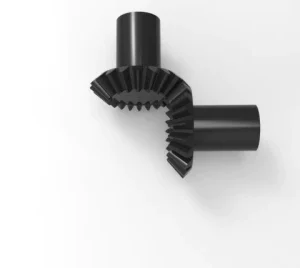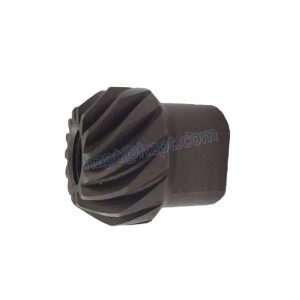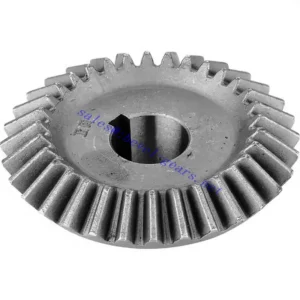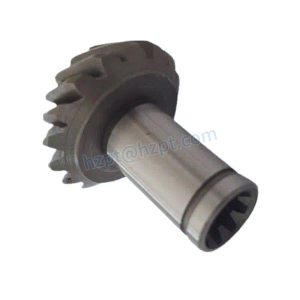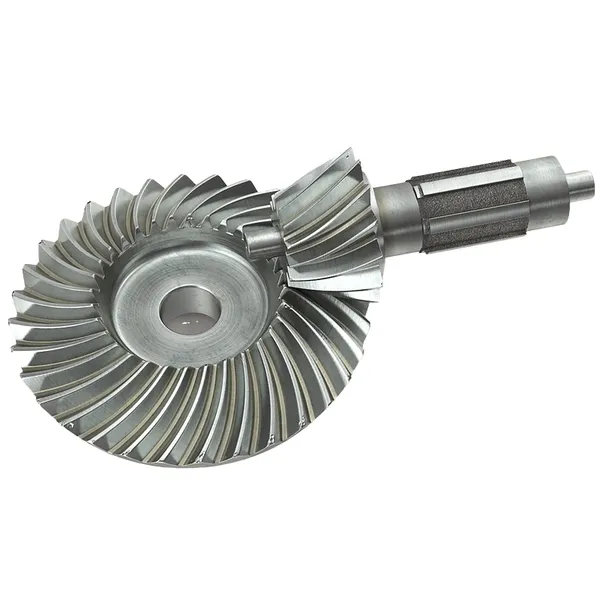
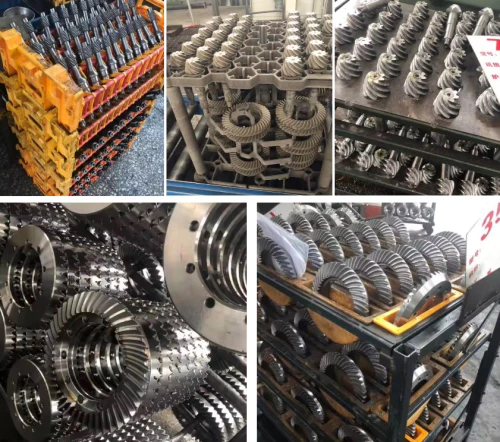
Spiral Bevel Gears (Helical Bevel Gear)
As one of the bevel gears manufacturers, suppliers, and exporters of mechanical products, We offer bevel gears and many other products.
Please get in touch with us for details.
Mail:[email protected]
Drivetrain inefficiency costs Australian mining, food processing, and transport operators an estimated $2.3 billion annually in wasted energy and unplanned maintenance — and the gear set at the right-angle drive is often where that loss begins. Spiral bevel gears, with their helical curved teeth, deliver 96–98% transmission efficiency per stage, measurably lower noise, and longer tooth life than straight bevel or spur alternatives. Australia Ever-Power, based at 27 Harley Crescent, Condell Park NSW 2200, supplies precision spiral bevel gears across Sydney, Melbourne, Brisbane, Perth, and Adelaide — custom-manufactured to ISO, DIN, and AGMA standards, with OEM/ODM capability and full quality documentation.
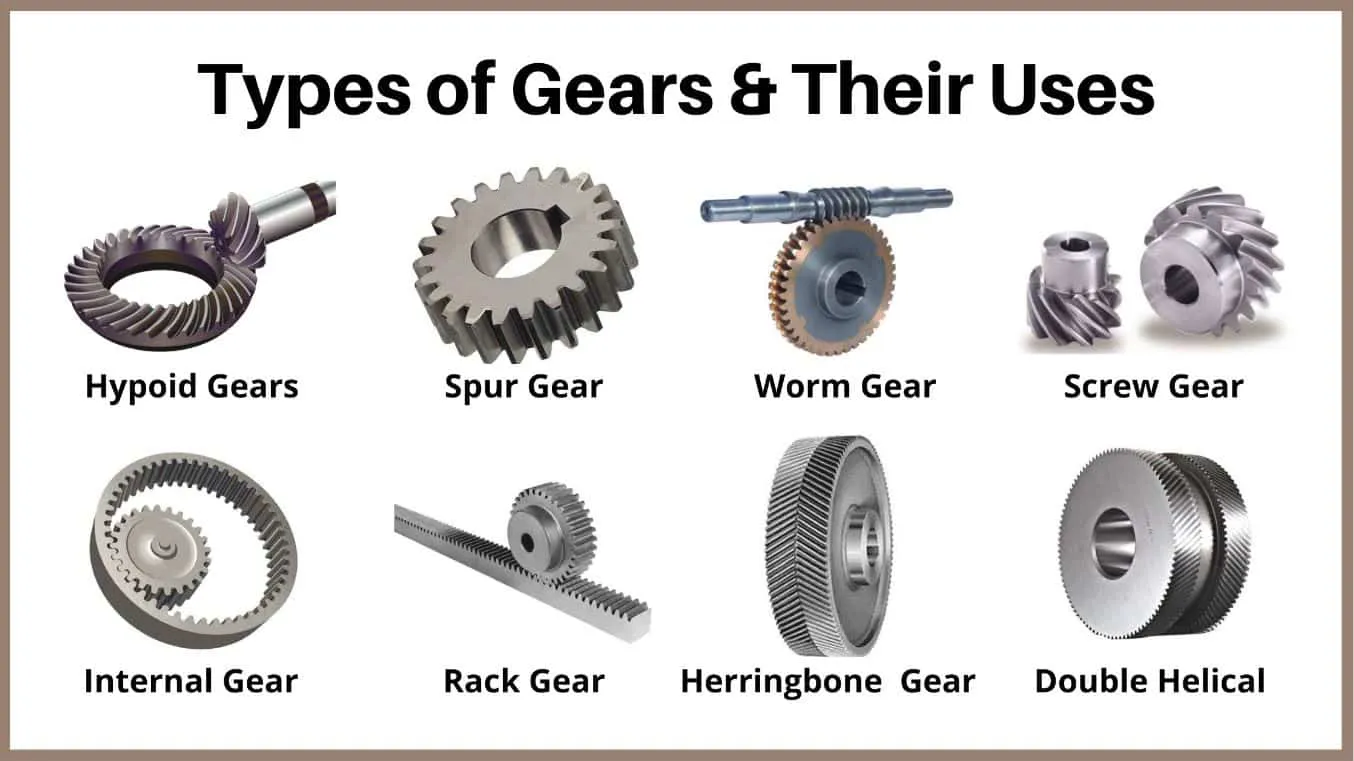
What Is a Spiral Bevel Gear?
A spiral bevel gear is a bevel gear in which the teeth are curved in a helical arc along the face of the cone, with a spiral angle typically between 25° and 35° at the pitch cone midpoint. Unlike straight bevel gears — where each tooth engages its mating tooth along the full face width simultaneously — spiral bevel teeth engage gradually from one end to the other, distributing load progressively across the tooth flank.
This progressive engagement is the source of the spiral bevel gear's core advantages: reduced impact loading, lower vibration, quieter operation, and greater load-carrying capacity for a given pitch diameter. The gear transmits torque between two intersecting shafts — typically at 90° — making it the standard choice wherever a right-angle direction change is required in a heavy-duty power transmission system.
Spiral bevel gears are manufactured using the Gleason method (circular arc tooth profile, dominant in Australia, North America, and Asia) or the Klingelnberg/Palloid method (involute tooth profile, more common in European applications). The two methods are not interchangeable — a Gleason pinion cannot mesh correctly with a Klingelnberg gear of nominally the same specification.
A critical maintenance rule governs replacement: spiral bevel gear sets must always be replaced in matched pairs. Pinion and gear are manufactured and lapped together as a matched unit; fitting a new gear against a worn pinion produces incorrect tooth contact and premature failure regardless of nominal specification match.
Spiral Bevel Gear vs Other Bevel Types: Choosing the Right Configuration
The four main bevel gear types each occupy a distinct performance and cost band. Selecting the wrong type for a given application is the most common source of avoidable gearbox failures in Australian heavy industry.
Straight Bevel
Simple, low-cost. Full-line tooth contact. Moderate noise. Max ratio ~5:1. Suitable for low-speed, moderate-load drives where budget is the primary driver.
Zero Degree Spiral (Zerol)
Curved teeth, zero midpoint spiral angle. Same bearing loads as straight bevel — direct drop-in replacement. Quieter than straight but lower load capacity than full spiral.
Spiral Bevel ★
Helical curved teeth. 96–98% efficiency. Max ratio ~10:1. Highest load capacity of intersecting-shaft types. Generates axial thrust — requires thrust bearings. Standard for heavy industrial and vehicle drives.
Hypoid Bevel
Offset non-intersecting axes. Max ratio ~25:1. ~90% efficiency per stage. Highest torque density but requires hypoid-specific gear oil. Standard in automotive rear axles.
Advantages and Limitations: An Honest Assessment
Understanding both sides of the spiral bevel gear's performance profile prevents misapplication — the most common root cause of early gear failure in Australian industrial facilities.
✅ Advantages
- 96–98% efficiency — highest of all right-angle bevel gear types
- Higher torque capacity — larger contact area than straight or Zerol for same pitch diameter
- Lowest noise of intersecting-shaft bevel options — progressive tooth engagement reduces mesh impact
- Compact power density — smaller gearbox envelope for equivalent rated power
- Longer service life — distributed load reduces contact stress and root bending moment
- Ratio up to 10:1 in a single stage — wider than straight bevel's 5:1 limit
- High-speed capable — ground pairs handle pitch line velocities above 25 m/s
⚠️ Limitations to Consider
- Higher cost than straight or Zerol bevel gears
- Must be replaced in matched pairs — pinion-only or gear-only replacement is not viable
- Precise shaft alignment required — cone distance to within ±0.025 mm for correct contact
- Generates significant axial thrust — bearing arrangement must be assessed before upgrading from straight bevel
- Not recommended above 10:1 single-stage ratio — noise and efficiency losses increase beyond this range
Key Specifications & Parameters
The table below covers the principal specification parameters for spiral bevel gears supplied by Australia Ever-Power. Custom configurations are available through OEM/ODM with engineering review within 48 business hours.
Material Selection Guide
How to Select the Right Spiral Bevel Gear for Your Application
A structured selection process prevents the most common spiral bevel gear failures reported by Australian maintenance engineers — mismatched pairs, undersized modules, and incorrect bearing arrangements.
Define Torque, Speed and Required Gear Ratio
Establish input torque (Nm), input speed (rpm), and required output ratio. Spiral bevel gears handle single-stage ratios up to 10:1. Use AGMA 2003 or ISO 10300 for tooth bending and contact stress calculations. Apply a service factor of 1.25–2.0 depending on duty cycle — higher values for shock-loading environments such as mining crushers and conveyor head drives common in Queensland and Western Australian operations.
Select Module Based on Torque and Space Envelope
Module determines tooth size and strength. Larger module means larger tooth height and face width — improving load capacity but increasing gear diameter. Verify the selected module and tooth count combination fits within the available cone distance for the housing. Australia Ever-Power's engineering team can run a module feasibility check from torque and space envelope data provided with the inquiry.
Choose Material and Heat Treatment
For heavy industrial and mining drives, specify 20CrMnTi with carburising and quenching to 58–62 HRC — the highest surface hardness and core toughness combination in the standard range. For food processing or pharmaceutical applications in Melbourne or Sydney, 316 stainless with nitriding provides corrosion resistance alongside adequate hardness. Avoid grey cast iron wherever shock loads or above-moderate speeds are present.
Specify Accuracy Grade
DIN Grade 5–6 suits precision machine tools, printing machinery, and high-speed drives. DIN Grade 7–8 covers the majority of Australian industrial gearboxes and mining drives. DIN Grade 9 is appropriate for low-speed rugged drives where cost is the priority. Each step finer in accuracy grade typically increases unit cost by 20–35%; each step coarser reduces it by a similar margin.
Confirm Bearing Arrangement for Axial Thrust
Spiral bevel gears generate axial thrust approximately equal to 0.70 × tangential load at 35° spiral angle. Confirm the existing bearing specification handles this load before upgrading from a straight bevel drive. Angular contact bearings or taper roller bearings are the standard solution. Failure to account for axial thrust is a leading cause of bearing overload failures in upgraded Australian conveyor and gearbox drives.
Always Budget for Matched Pair Replacement
Plan for pinion and gear replacement together. Spiral bevel gears are lapped as matched pairs during manufacture — the contact pattern is optimised for that specific pair. Fitting a new gear against a worn pinion (even nominally identical specification) produces suboptimal contact and typically halves service life. This rule applies regardless of which member shows visible wear first, and should be factored into the maintenance budget from day one.
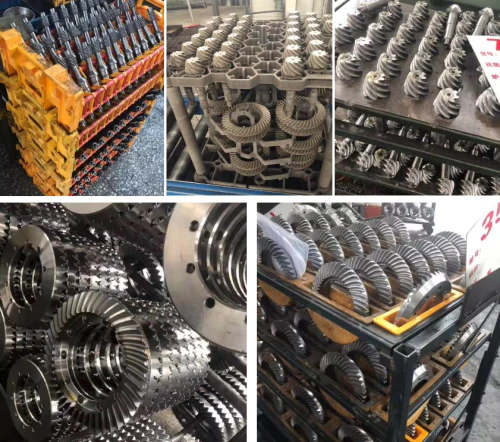
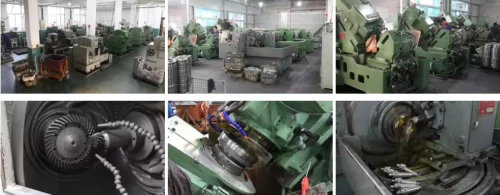
How Spiral Bevel Gears Are Manufactured
The production sequence for spiral bevel gears is more involved than for spur or straight bevel gears — which is reflected in higher unit cost and significantly better performance when the process is followed correctly.
① Blank Pre-Forming
Forged or rolled steel blanks produced to rough shape. Forging preferred for high-load gears — favourable grain flow improves tooth root fatigue life by 25–40% versus bar stock.
② Annealing
Cast or forged blanks annealed to relieve internal stress before CNC turning. Ensures dimensional stability in subsequent machining operations.
③ Gleason Gear Cutting
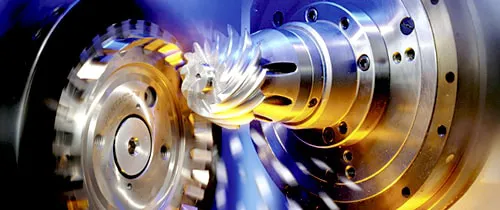
CNC Gleason generators produce the spiral tooth profile to specified module, spiral angle, and pressure angle. Both pinion and gear cut to matched pair settings simultaneously.
④ Case Hardening
Carburising and quenching achieves 58–62 HRC surface hardness with a tough core for alloy steel gears. Heat treatment curve supplied with each documentation package.
⑤ Grinding and Lapping
Post-hardening grinding restores tooth profile to final DIN accuracy. Pinion and gear lapped together as a matched pair — contact pattern verified with marking compound before release.
⑥ Final Inspection
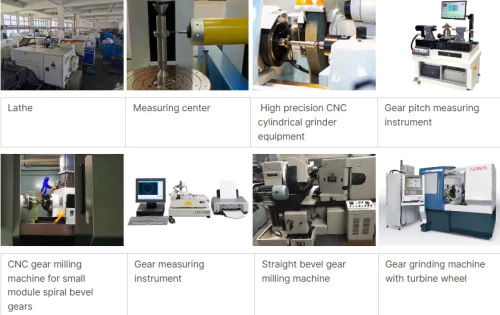
Gear measuring machine verifies tooth pitch, profile, runout, and spiral angle. CMM confirms bore and mounting dimensions. Full QA documentation issued per order.
Applications of Spiral Bevel Gears in Australian Industry
Spiral bevel gears appear wherever high-efficiency right-angle power transmission is needed at load levels that rule out straight bevel alternatives. Australian operators in the following sectors rely on them as critical drive components.
⛏️ Mining and Resources
Bucket wheel excavators, stacker/reclaimer drives, dredger winches, mill drive gearboxes, and belt conveyor head drives across Queensland, Western Australian, and South Australian mine sites. Heavy alloy steel spiral bevel sets with carburised teeth handle shock loads and continuous duty cycles of open-cut and underground operations.
🚛 Automotive and Transport
Vehicle differentials, truck final drives, and agricultural tractor PTO drives use spiral bevel gear sets. The 96–98% efficiency advantage over hypoid gears translates to fuel savings of 1–3% per vehicle in Australian transport fleets where right-angle drive configuration is compatible with spiral bevel geometry.
🍞 Food Processing and Packaging
Stainless steel spiral bevel gears in FSANZ-compliant drives handle mixing, filling, and conveying in Melbourne and Sydney food manufacturing plants. Spiral geometry reduces shift-average noise exposure by 4–8 dB(A) versus straight bevel alternatives — a measurable workplace health benefit under SafeWork Australia guidelines.
🖨️ Printing and Packaging Machinery
High-speed offset printing presses use spiral bevel gears to synchronise multiple rollers. At pitch line velocities above 15 m/s, only ground spiral bevel gears provide the accuracy grade necessary to prevent colour registration errors — a quality-critical parameter for commercial printers in Sydney and Brisbane.
⚙️ Industrial Speed Reducers
Right-angle bevel gearboxes fitted to mixers, agitators, cooling tower fans, and pump drives across Australian process industries use spiral bevel pairs as their primary reduction stage. The 10:1 single-stage capability often eliminates the need for a compound reducer — reducing gearbox cost and maintenance points.
✈️ Aerospace Ground Support
Air pre-heater drives, aircraft ground power units, and high-speed test benches at Australian defence and aviation facilities require spiral bevel gears in DIN Grade 5–6 from specific alloy steels, with full QA documentation covering chemical composition, mechanical properties, and dimensional verification.
Maintaining Spiral Bevel Gears: Field-Proven Practices
Spiral bevel gear failures in Australian heavy industry are most commonly caused by improper installation, lubrication neglect, or mismatched replacement parts — all preventable with disciplined maintenance practice.
- Lubrication: Use ISO VG 220–460 EP gear oil. The extreme pressure additive package is essential — spiral bevel tooth contact pressures can exceed 1,500 MPa under peak load. Do not use hypoid GL-5 oil unless specifically approved by the gearbox OEM, as hypoid additives can corrode yellow metal bearings in some bevel gear housings.
- Oil change intervals: Change at 2,000–4,000 operating hours or annually — whichever comes first. In high-ambient-temperature environments (Queensland and WA summer conditions), shorten intervals by 30% to compensate for accelerated oil degradation.
- Tooth contact pattern: At every major overhaul, verify the contact pattern with engineer's blue. The contact ellipse should sit centred on the tooth flank — approximately 65–70% of tooth length and 50–60% of depth. An edge-loaded contact indicates incorrect cone distance setting; correct before returning to service.
- Backlash: Measure at the pitch radius with a dial indicator. For M8 spiral bevel gears, allowable backlash is approximately 0.20–0.35 mm. Below minimum suggests the gear pair was set up too tightly — overheating and surface fatigue follow. Above maximum indicates tooth wear or bearing failure.
- Replace in pairs: If inspection reveals one member worn beyond limits, budget for both pinion and gear replacement. Fitting a new gear against a worn pinion is the single most common cause of premature spiral bevel gear failure in Australian plant maintenance records.
- Bearing preload: Restore bearing preload at each overhaul. A change of 0.1 mm in mounting distance moves the contact patch by approximately 20% of tooth length, significantly increasing stress concentration and accelerating surface fatigue.
Spiral Bevel Gear Pricing: What Australian Buyers Should Budget
Pricing varies substantially by module, material, accuracy grade, and volume. The table below provides realistic benchmarks for Australian procurement teams building initial sourcing comparisons.
Indicative figures for M5–M10 steel spiral bevel pairs, DIN Grade 7. Final pricing depends on module, material, accuracy, and volume.
Why Australian Industrial Buyers Choose Australia Ever-Power
Australia Ever-Power focuses exclusively on bevel gear supply from 27 Harley Crescent, Condell Park NSW 2200. That focus means the team brings deep practical knowledge of spiral bevel gear selection, failure analysis, and replacement planning to every order discussion.
Certified Matched Pairs
Pinion and gear supplied as a lapped, matched pair with verified contact pattern — never mismatched components. Contact certificate included.
Full QA Documentation
Chemical, mechanical, heat treatment, and dimensional reports per order — supporting Australian mining, food, and government procurement QA requirements.
Nationwide Express Delivery
DHL and UPS reach Sydney, Melbourne, Brisbane, Perth, Adelaide, and Darwin within 3–7 business days. Urgency upgrades available for breakdown situations.
OEM / ODM and Reverse Engineering
Submit drawings or send worn gears for reverse engineering. DFM feedback within 48 business hours. Custom alloy steel, stainless, and special-material pairs manufactured to order.
ISO 9001:2015 Certified
Quality system covering all production stages — the standard prerequisite for supply into Australian mining, food processing, and government infrastructure projects.
Australian Business Hours Support
Technical and procurement queries answered during AEST/AEDT hours. Practical gear engineering knowledge applied to every order and specification discussion.
What Australian Operators and Engineers Say
"We replaced straight bevel gear sets in three conveyor head drives with spiral bevel pairs from Australia Ever-Power. Gearbox oil temperature dropped by an average of 8°C — consistent with the efficiency improvement spiral bevel geometry delivers. Noise at the operator platform also dropped noticeably. Eighteen months in, no service issues across all three drives."
"Our high-speed offset press required DIN Grade 6 spiral bevel gears in 20CrMnTi with ground teeth. Australia Ever-Power understood why Grade 6 mattered for register accuracy and could certify to that level. The matched pair came with a full contact pattern certificate, which our press OEM accepted for the warranty record. Lead time was 22 days — reasonable for the complexity involved."
"We source stainless spiral bevel pairs for our food processing mixer drives in Brisbane. Quality and documentation are consistently good — FSANZ compliance is straightforward with the material certs provided. Pricing is around 45% below our previous European supplier at our annual volume. Four stars rather than five only because custom lead times occasionally stretch past the quoted 20 days during peak periods."
"A key speed reducer in our Sydney plant failed with no original gear documentation. We sent the worn pair to Australia Ever-Power for reverse engineering. They recovered the full specification from the damaged parts and delivered a replacement matched pair within 24 days. The new set installed correctly first time and the contact pattern matched OEM specification dimensions we eventually located after the fact."
Frequently Asked Questions — Spiral Bevel Gears
Sustainability and Regulatory Compliance
The 96–98% efficiency of spiral bevel gears carries a direct sustainability benefit. For a 100 kW gearbox running 6,000 hours per year, upgrading from a 93% efficient alternative to a 97% spiral bevel set saves approximately 24,000 kWh annually — equivalent to roughly 21 tonnes of CO₂ at Australia's current grid emission factor.
Quality management certification covering all production stages — prerequisite for Australian mining, food, and government supply chains.
Hazardous substance declarations available — supporting Australian exporters whose equipment ships to EU or other regulated markets.
Alloy steel and stainless gears are fully recyclable at end-of-service — supporting GRI or CDP sustainability reporting for Australian operators.
Full material batch traceability from mill certificate to finished gear — supporting Australian defence, infrastructure, and mining QA chain-of-custody requirements.
Source Precision Spiral Bevel Gears for Your Australian Operation
Contact Australia Ever-Power at 27 Harley Crescent, Condell Park NSW 2200. We supply ISO-certified, matched-pair spiral bevel gears in alloy steel, stainless, and special materials — DIN Grade 5–9, OEM/ODM accepted, full QA documentation, express delivery to Sydney, Melbourne, Brisbane, Perth, and Adelaide.