
The Cornering Problem That Every Driven Vehicle Must Solve
When a vehicle turns a corner, the two driven wheels on the same axle travel different distances — the outer wheel follows a larger arc and must rotate faster than the inner wheel. The difference in rotation speed depends on the corner radius and the axle track width, and it can be substantial even in gentle curves. For a standard passenger car with a 1.5-metre track width negotiating a 10-metre corner radius, the outer wheel must complete approximately 15% more revolutions than the inner wheel in the same time. If both wheels were rigidly connected to the same shaft, one or both would have to slip against the road surface on every bend, causing tyre wear, loss of steering control, and mechanical strain across the entire drivetrain.
The automotive differential was developed precisely to solve this problem: it delivers equal torque to both driven wheels while allowing them to rotate at different speeds whenever cornering, road surface irregularities, or wheel size differences demand it. Inside every open differential is a set of bevel gears — specifically, a ring-and-pinion spiral bevel or hypoid pair for the main drive, and a set of small straight bevel gears (the spider and side gears) for the speed-differencing function. These bevel gears perform their job silently inside the axle housing for hundreds of thousands of kilometres without the driver or passenger ever being aware of their operation.
Australia Ever-Power at Condell Park NSW 2200 supplies replacement differential bevel gear sets for passenger vehicles, commercial vehicles, four-wheel-drive trucks, and industrial wheeled equipment across Australia. Contact our engineering team at [email protected] for replacement specifications.
The Differential Mechanism: Bevel Gears at Every Stage
Stage 1 — The Ring-and-Pinion: Direction Change and Speed Reduction
The engine drives the transmission, which connects via the propeller shaft (driveshaft) to the pinion gear at the front of the differential. This pinion is a spiral bevel gear (or hypoid gear in virtually all modern vehicles) that meshes with the large ring gear at 90°, redirecting the longitudinal rotation of the driveshaft into transverse rotation aligned with the wheel axles. The ring-and-pinion ratio — typically 3:1 to 4.5:1 in passenger cars, up to 6:1 in heavy trucks — provides the final speed reduction in the vehicle’s drivetrain, multiplying the torque from the transmission output by the ring-and-pinion ratio before delivering it to the wheels.
The ring gear is bolted to the differential case, a cast iron or forged steel housing that rotates with the ring gear and carries the spider gear assembly inside it. The case turns at the ring gear speed — reduced from driveshaft speed by the ring-and-pinion ratio. Everything inside the differential case rotates with it as a unit when both wheels are turning at the same speed (straight-line driving). When the wheels need to turn at different speeds — on a corner or over a bump — the spider bevel gears inside the case provide the differencing action that allows this.
Stage 2 — Spider and Side Gears: The Speed-Differencing Bevel Set
Inside the rotating differential case sit two or four small straight bevel gears mounted on a cross-pin (the spider shaft) fixed to the case. These spider gears mesh with two side gears — also straight bevel gears — that are splined to the left and right axle shafts. When the vehicle drives in a straight line and both wheels turn at the same speed, the spider gears do not rotate on their own axes; they simply orbit with the case, transmitting torque equally to both side gears and thus both wheels. When cornering, the outer wheel needs to rotate faster than the inner wheel — the spider gears respond by rotating on their own axes (spinning on the cross-pin), allowing the side gears and the wheel axles connected to them to rotate at different speeds. This rotation absorbs the speed difference without any slippage, torque disruption, or mechanical stress on the axle shafts.
Why Bevel Gears — Not Worm, Spur, or Helical?
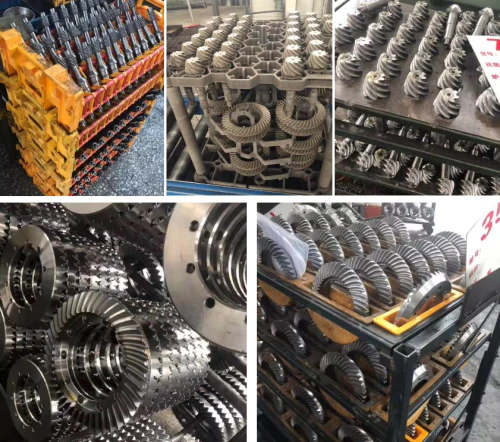
The differential mechanism requires gear types capable of transmitting power between intersecting shafts at right angles (for the ring-and-pinion) and between coaxial but independently rotating shafts (for the spider-and-side gear assembly). Spur and helical gears can only connect parallel shafts and are geometrically incapable of performing either of these functions. Worm gears can change direction through 90° but are self-locking below certain lead angles, which would prevent the differential from allowing speed differences — defeating the entire purpose of the mechanism. Bevel gears are the only gear type that satisfies all three requirements simultaneously: 90° power transmission, high efficiency (97–99%), and full speed differencing capability with no self-locking tendency.
The efficiency consideration is critical in automotive applications. A worm gear achieving 90° power transmission typically operates at 70–90% efficiency — the remaining 10–30% is dissipated as heat. For a 100 kW vehicle powertrain, a 10% efficiency loss at the rear axle would require a 10 kW cooling system just for the differential gear losses. Spiral bevel and hypoid gear differentials achieve 97–99% efficiency, producing negligible heat at the final drive stage and contributing minimally to vehicle fuel consumption. Over the life of a vehicle that travels 300,000 km, the efficiency advantage of bevel gears over worm gears at the rear axle represents a substantial reduction in total fuel consumed.
The torque capacity per unit weight is another decisive advantage. Automotive rear axle packaging constraints are severe — the differential must fit within a defined axle housing envelope while transmitting full vehicle torque. Bevel gears achieve higher torque-per-weight ratio than worm gears of equivalent centre distance, enabling the compact, lightweight axle designs that vehicle manufacturers require. The hypoid offset specifically allows the ring gear to be larger relative to the pinion — increasing torque capacity further — while lowering the driveshaft line and reducing vehicle floor height in rear-wheel-drive applications.
Six Reasons Bevel Gears Cannot Be Replaced in Differentials
The driveshaft runs fore-aft; the wheel axles run side-to-side. Only bevel gears can redirect full drive torque through 90° with the efficiency, compactness, and load capacity the application demands. No substitute exists at automotive power levels.
Automotive manufacturers target every fraction of a percent in drivetrain efficiency for fuel economy and range. The 97–99% efficiency of spiral bevel or hypoid differentials cannot be matched by worm gears or other right-angle alternatives at the required torque levels.
The bevel spider-and-side gear arrangement naturally provides equal torque to both driven wheels regardless of their relative speed — the defining characteristic of an open differential. No other gear arrangement achieves this combination passively without clutch packs or electronic intervention.
The hypoid ring-and-pinion package is among the most torque-dense of any gear arrangement. A 250 mm ring gear transmitting 3,500 Nm of wheel torque in a vehicle weighing 2,500 kg represents remarkable engineering density.
Lapped spiral bevel or hypoid differential gears, correctly lubricated and assembled, operate virtually silently at all vehicle speeds. The acoustic refinement achievable with modern Gleason gear geometry optimisation cannot be matched by alternative right-angle gear types.
The hypoid differential bevel gear set has been manufactured and refined continuously since the 1920s. The design is mature, well-characterised, and supported by accumulated manufacturing knowledge and tooling infrastructure that gives it an inherent advantage over any potential replacement technology.
Types of Bevel Gear Differentials: Beyond the Open Diff
The open differential described above is the simplest bevel gear differential configuration — but it has a well-known limitation: when one driven wheel loses traction (on ice, mud, or when lifted off the ground), the differential delivers power to the wheel with least resistance, which is the spinning wheel. The driven wheel with traction receives no additional torque. Several enhanced differential designs address this limitation, all retaining the bevel gear architecture of the open differential but adding torque-biasing mechanisms.
Limited-Slip Differential (LSD)
Retains the standard bevel spider-and-side gear arrangement but adds friction clutch packs or Torsen gear mechanisms between the differential case and the side gears. When speed difference between the two side gears exceeds a threshold, the clutches engage and provide resistance to further differencing — biasing torque toward the wheel with traction. LSDs are standard equipment on sports vehicles, performance utes, and off-road vehicles in Australia.
Locking Differential (Diff Lock)
A dog clutch mechanism mechanically locks the side gears to the differential case, forcing both axle shafts to rotate at exactly the same speed regardless of traction conditions. The bevel spider gears remain in the housing but no longer rotate on their axes. Used in serious off-road 4WD applications and heavy trucks — maximum traction on low-grip terrain at the cost of inability to corner normally under lock engagement.
Torsen (Torque-Sensing) Differential
Uses helical gear worm elements alongside the bevel side gears to bias torque proportionally between the axle shafts in response to the torque difference signal. No clutch packs — entirely mechanical gear-based bias. Standard on some high-performance vehicles and Audi Quattro systems. The bevel gear foundation remains intact; the worm gears add bias rather than replace the speed-differencing function.
Electronic Limited Slip (eLSD)
An electronically controlled clutch pack modulates bias based on wheel speed sensor data, vehicle speed, steering angle, and yaw rate. The open bevel gear differential handles normal driving; the electronics engage the clutch when traction control algorithms detect impending wheel slip. Increasingly standard on modern performance and all-wheel-drive vehicles — the bevel gear set remains central, the electronics manage when to engage the torque bias.
Differential Gear Failure: Causes and Warning Signs
Automotive differential bevel gears are among the most durable components in a vehicle drivetrain — properly lubricated and operated within their load rating, they routinely last the full vehicle service life. When they do fail prematurely, the causes are almost always traceable to lubricant neglect, overloading from aggressive 4WD operation, or mechanical damage from wheel spin events that spike differential internal torques far above the rated design load.
Common Causes of Differential Failure
Oil neglect
Differential oil is often forgotten in vehicle service schedules. Degraded oil loses its EP additive protection and film-forming capability, causing rapid hypoid tooth scuffing. Change differential oil every 50,000–80,000 km in normal use; more frequently in towing or 4WD applications.
Wrong lubricant
Hypoid differentials require GL-5 rated hypoid gear oil — not standard engine oil, ATF, or GL-4 gear oil. Using an incorrect lubricant in a hypoid differential causes rapid tooth scuffing within weeks of operation under load.
Aggressive wheel spin
High-speed wheel spin events — drag racing launches, recovery from getting bogged — rapidly spin the spider gears on their cross-pins at very high speed. The cross-pins and spider gear bores heat from friction in seconds, causing galling of the steel-on-steel surfaces and sometimes cross-pin fracture.
Prop shaft or axle shaft misalignment
Incorrect driveshaft yoke angles transmit vibration into the pinion bearing, which shifts the ring-and-pinion contact pattern over time. Incorrectly installed axle shafts can misalign the side gears, increasing spider gear loading on one side.
Warning Signs of Differential Gear Wear
A whining or howling noise from the rear axle that changes with vehicle speed (but not with throttle input) typically indicates ring-and-pinion wear — the noise frequency corresponds to ring gear tooth frequency (vehicle speed × ring gear teeth per revolution). A clunking or clicking noise specifically during cornering — when the spider gears are rotating actively — points to spider gear or cross-pin wear. A rumbling vibration that changes with vehicle load (not just speed) can indicate ring gear runout from worn or incorrectly preloaded pinion bearings. Any of these symptoms warrants a differential inspection before the wear progresses to fracture or seizure.
Differential Gear Replacement Costs: Market Reference (AUD)
Indicative pricing for replacement differential bevel gear sets in the Australian market. OEM pricing varies widely by vehicle brand. Contact [email protected] for non-standard or commercial vehicle specifications.
| Application | Gear Type | OEM / Dealer Price | Ever-Power Replacement |
|---|---|---|---|
| Passenger car rear axle (standard) | Hypoid 4:1 | $600–$1,400 | $400–$900 |
| 4WD ute / SUV rear axle | Hypoid 3.9–4.1:1 | $900–$2,200 | $650–$1,400 |
| Light commercial vehicle (van/cab chassis) | Hypoid 4.1–5.1:1 | $1,200–$2,800 | $800–$1,800 |
| Heavy truck / semi-trailer tandem axle | Hypoid 4.1–6.1:1 | $2,800–$7,500 | $1,800–$5,000 |
| Mining haul truck / heavy machinery axle | Hypoid / spiral bevel | $8,000–$25,000+ | $5,500–$18,000 |
The Future: Differential Bevel Gears in Electric Vehicles
A frequently asked question is whether the shift to battery-electric vehicles (BEVs) makes differential bevel gears obsolete. The answer is nuanced. Some BEV architectures use individual wheel motors — one electric motor per driven wheel — eliminating the need for a mechanical differential entirely because each motor’s torque can be independently controlled by software. However, this architecture adds significant unsprung weight and electrical system complexity that not all vehicle platforms accept.
Many production BEVs — including high-volume platforms from Tesla, BYD, and others — use a single rear or front motor connected through a reduction gear and a conventional hypoid or spiral bevel differential to drive both wheels. This architecture retains the familiar ring-and-pinion bevel gear set and spider gear differential mechanism, because it provides proven efficiency, durability, and manufacturing simplicity that individual wheel motor systems cannot yet match at competitive cost in mainstream applications. The global shift to electrification is therefore not eliminating bevel gear differentials — it is changing the input torque source from an internal combustion engine to an electric motor, while the bevel gear differential stage continues to perform its essential function unchanged.
From a regulatory compliance perspective, Australian automotive components must meet ADR (Australian Design Rule) standards governing vehicle safety and performance. Replacement differential gear sets in compliant vehicles must restore the original performance standard — fitting lower-quality replacement gears that alter the axle’s load capacity or gear ratio changes the vehicle’s compliance status. Ever-Power supplies replacement differential gear sets that restore OEM specification with documented material quality, ensuring continued ADR compliance for the modified axle.
Components of the Differential Bevel Gear Assembly
Ring Gear (Crown Wheel)
Large hypoid ring gear bolted to the differential case. Case-carburised 8620 steel, lapped to the mating pinion. Tooth count typically 37–45 for passenger vehicles. Matched set with pinion — replace only as a pair.
Drive Pinion
Hypoid pinion on splined shaft, integral with the drive flange. Tooth count typically 9–14 teeth. Mounted in tapered roller bearings with precise preload; bearing preload must be re-set at replacement to restore contact pattern and noise performance.
Spider Gears (Pinion Mates)
Two or four straight bevel gears mounted on the cross-pin inside the differential case. These small gears perform the speed-differencing function. Typically through-hardened 4140 steel, ground or lapped for low friction on the cross-pin.
Side Gears (Axle Bevel Gears)
Left and right straight bevel gears splined to the axle shafts. Mesh with the spider gears. Thrust washers behind the side gears control axial position and friction; worn washers increase spider gear load asymmetry.
Differential Case (Carrier)
Cast iron or forged steel housing that carries the ring gear, spider gear cross-pin, and side gear assembly. Must maintain rigid bore alignment for correct contact pattern — inspect for distortion if gear noise develops after assembly.
Hypoid Gear Oil (GL-5)
Mandatory GL-5 rated hypoid gear oil with sulfur-phosphorus EP additives. Non-negotiable specification — using alternative lubricants causes rapid scuffing failure. Change every 50,000–80,000 km for standard use; more frequently for towing and 4WD use.
Automotive Customer Reviews
“Had a whining rear diff on our fleet of delivery vans — 15 vehicles. The OEM replacement price was going to cost us $28,000. Ever-Power matched the spec, delivered with material certs, and saved us over $9,000 across the fleet. Gears are now 80,000 km in with no issues.”
“Our road train tandem axle had a catastrophic diff failure in the middle of outback SA. Ever-Power got us a replacement ring-and-pinion inside 8 days freight-to-site. Correct ratio, correct documentation. Driver was back on road in 10 days.”
“We were rebuilding a high-performance ute diff with an upgrade ring-and-pinion ratio. Ever-Power understood the hunting tooth ratio requirement and supplied a 4.11:1 set with coprime tooth counts. Installation was textbook — quiet, smooth, exactly the ratio we needed.”
“Mining haul truck diff sets are a major cost line for us. We tested Ever-Power’s gear sets against the previous supplier across four trucks — lower price, same spec, better documentation. After 12,000 operating hours all four sets are performing within normal wear parameters.”
Frequently Asked Questions: Differential Bevel Gears
Differential Bevel Gear Specialists — Australia Ever-Power
Australia Ever-Power · Condell Park NSW 2200 · Replacement and custom differential gear sets for passenger, commercial, and heavy transport applications across Australia.