
The Understated Importance of Getting Backlash Right
Backlash is the clearance between the non-driving flanks of mating gear teeth — the small gap that allows the driven tooth to be lightly displaced from the driver tooth in the circumferential direction without transmitting load. This seemingly minor detail has major consequences for gear assembly quality: too little backlash causes tooth interference under thermal expansion or deflection, generating rapid wear and overheating; too much backlash allows excessive impact loading on gear reversal, shifts the contact pattern toward the tooth heel, and increases noise from the periodic impact as the slack is taken up each revolution.
The professionals who need to understand backlash adjustment extend well beyond gear manufacturers. Gearbox rebuilders must re-establish the correct value after replacing bearings or seals. Machinery installation engineers must verify backlash before commissioning a new gearbox. Maintenance engineers investigating noise complaints must check whether backlash has changed from its commissioning value as an early diagnostic step. Procurement engineers specifying replacement gear sets must understand the relationship between backlash and mounting distance to order the correct shim pack thickness. Each of these roles requires a working understanding of the same underlying principle.
Australia Ever-Power at Condell Park NSW 2200 provides backlash verification reports with all gear sets supplied, and assists customers with backlash diagnosis and correction via our technical support service at [email protected].
What Is Backlash and Why Does It Exist?
Backlash in a bevel gear set is intentionally designed into the tooth geometry by setting the mounting distances slightly larger than the theoretical zero-backlash position. The purposes of backlash are multiple and interconnected. First, it accommodates thermal expansion: as the gearbox heats from ambient to operating temperature, both the gears and the housing expand. The housing typically has a larger thermal expansion coefficient than the gear steel, which moves the gears slightly closer together — if zero backlash were set at ambient temperature, the gears would interfere and potentially seize at operating temperature.
Second, backlash accommodates the lubricant oil film. A correctly functioning EHD oil film between tooth surfaces has finite thickness — typically 0.002 to 0.010 mm depending on operating conditions. This film requires clearance to exist; zero-backlash gear pairs running with a thick oil film would generate hydraulic pressure within the mesh that raises the effective contact stress beyond the design assumption. Third, backlash accommodates the small shaft deflections that occur under load — without clearance, the slight bowing of loaded shafts would shift the effective mounting distance and cause interference at tooth ends.
Backlash is typically specified as the circumferential backlash jt — the gap measured tangentially at the ring gear pitch radius with the pinion fixed. For a bevel gear with outer module me, the standard normal backlash jn at the midface is approximately 0.03 to 0.05 × me for general industrial applications, corresponding to circumferential backlash values in the ranges shown in the table below.
How to Measure Bevel Gear Backlash Correctly
Position the dial indicator correctly
Mount a dial indicator with a magnetic base so the indicator tip contacts the face of a ring gear tooth at the mid-face radius, in the tangential direction (at a right angle to the tooth face). The indicator must be set tangentially — not radially — to measure the circumferential backlash directly. A radially positioned indicator will underread the backlash by a factor of cos(pressure angle).
Fix the pinion shaft rigidly
Lock the pinion shaft so it cannot rotate — use a spanner flat, clamped coupling, or suitable fixture. The pinion must be completely stationary; any axial or rotational play in the pinion fixture will be read as part of the backlash measurement, giving a falsely high reading. If the pinion bearings have axial play, address this first.
Rock the ring gear and read the indicator
Rock the ring gear gently back and forth by hand — the full circumferential backlash is the total indicator travel between the two tooth contact limits. Set the indicator to zero on one limit, rock to the other, and read the value. Measure on 3–4 different teeth around the ring gear and record all values; the range should be within ±15% of the mean for a well-made gear set.
Convert to normal backlash if needed
The measured circumferential backlash jt can be converted to normal backlash jn (the gap measured perpendicular to the tooth surface) using: jn = jt × cos(pressure angle) × cos(spiral angle). For a 20° pressure angle, 35° spiral angle gear: jn = jt × cos(20°) × cos(35°) = jt × 0.9397 × 0.8192 = jt × 0.770.
Compare against specification and accept or adjust
Compare the measured mean backlash against the specification table for the module (see table below). If within range — accept. If outside range — adjust the ring gear mounting distance shim (moving ring gear toward pinion reduces backlash; moving away increases backlash). Adjust in steps of 0.05–0.10 mm, re-measure after each adjustment, and verify the contact pattern has not been adversely affected by the change.
Backlash Reference Table by Module (Circumferential jt, mm)
Standard industrial applications, measured at ring gear mid-face tangentially. High-temperature and reversing drives require values toward the upper limit.
| Outer Module me | Min jt (mm) | Max jt (mm) | Nominal jt | Typical Application |
|---|---|---|---|---|
| 2 | 0.06 | 0.13 | 0.09 | Instruments, light machinery |
| 3 | 0.09 | 0.18 | 0.13 | Food processing, automotive |
| 4 | 0.12 | 0.25 | 0.18 | General industrial gearboxes |
| 6 | 0.18 | 0.36 | 0.26 | Agricultural, medium industrial |
| 8 | 0.24 | 0.48 | 0.35 | Mining, heavy machinery |
| 12 | 0.36 | 0.70 | 0.50 | Large industrial, marine |
The Backlash–Contact Pattern Relationship: They Are Not Independent
A critical subtlety that many maintenance engineers miss is that backlash and contact pattern are controlled by the same shim adjustments and are therefore not independently adjustable. When you move the ring gear toward the pinion to reduce backlash, you simultaneously move the contact pattern toward the tooth tip. When you move the ring gear away to increase backlash, the contact pattern shifts toward the tooth root. Similarly, moving the pinion toward the ring gear reduces pinion mounting distance, shifts the contact pattern toward the tooth heel, and reduces backlash. Moving the pinion away increases mounting distance, moves contact toward the toe, and increases backlash.
This interdependency means that whenever a backlash adjustment is made, the contact pattern must be re-verified. A backlash correction that puts the contact pattern into tip or root contact is not acceptable, even if the backlash value is now correct — because tip or root contact concentrates the tooth load in a way that accelerates fatigue damage. The correct assembly procedure always achieves both correct backlash and correct contact pattern simultaneously, which requires iterative adjustment with both engineer’s blue and the dial indicator in use together.
The proper adjustment sequence is: first establish correct contact pattern by adjusting pinion mounting distance, then fine-tune backlash by adjusting ring gear mounting distance. Because ring gear movement primarily affects backlash with secondary effect on contact pattern (mostly tip/root shift), this sequence allows both targets to be reached without the adjustments interfering with each other as severely as they would if both were adjusted simultaneously without a defined sequence.
Who Specifically Needs to Understand Backlash Adjustment
🔧 Gearbox Rebuilders
Must re-establish the correct shim pack whenever bearings, seals, or gears are replaced. The original shim configuration is often lost during disassembly if not documented. Rebuilders who omit backlash verification after assembly send equipment back into service with an unknown and potentially incorrect tooth contact condition.
🏗️ Installation Engineers
New gearbox installations require backlash verification before commissioning. Transportation, thermal cycling during shipping, and housing distortion during structural installation can all shift the effective mounting distance from the factory-set value. A verification step before first operation is mandatory.
📊 Maintenance Engineers
Backlash change from the commissioning value is an early indicator of bearing wear, gear tooth wear, or housing distortion. Tracking backlash at scheduled maintenance intervals provides a quantitative trend that flags developing problems before audible noise or vibration symptoms appear.
📋 Procurement Engineers
Understanding the relationship between gear module, mounting distance, and backlash allows procurement engineers to specify the correct shim pack thickness when ordering replacement gear sets — rather than relying on the maintenance department to figure it out during installation.
🔍 Failure Investigators
Post-failure analysis of bevel gear failures must include a backlash assessment of the mating surfaces and housing. Wear patterns consistent with excessive backlash (heavy heel contact) or insufficient backlash (tip contact pitting) are among the most informative failure signatures for identifying the root cause.
✍️ Design Engineers
Gearbox housing designers must dimension bearing bore positions, shim land dimensions, and access port locations to enable backlash measurement in service. Housings that make backlash measurement difficult or impossible create maintenance problems that persist for the life of the equipment.
Most Common Backlash Adjustment Errors and Their Consequences
| Error | Result | Correction |
|---|---|---|
| Backlash too small | Tip contact, overheating, seizure | Move ring gear away from pinion (increase shim) |
| Backlash too large | Root contact, impact on reversal, noise | Move ring gear toward pinion (reduce shim) |
| Measured radially not tangentially | Underreads by ~6–10% | Reposition indicator tip tangentially at pitch radius |
| Pinion not fixed during measurement | Overreads; false high backlash value | Clamp pinion shaft rigidly before measuring |
| Backlash corrected, contact pattern not rechecked | Tip or root contact introduced | Always re-verify contact pattern after any adjustment |
| Using ambient-temperature spec for high-temp application | Tight at operating temperature | Increase backlash by ΔT × α × mounting distance for expected temp rise |
Why Australia Ever-Power Gear Sets Arrive Correctly Set
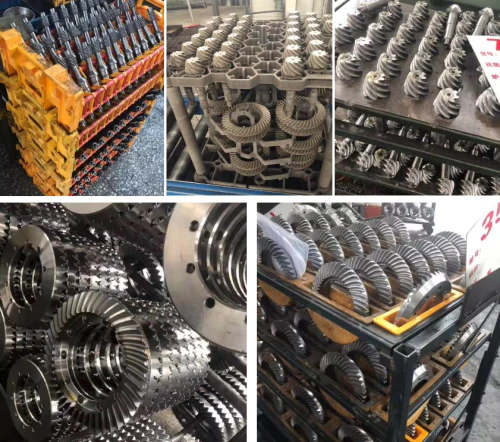
Every spiral bevel gear set supplied by Australia Ever-Power undergoes backlash verification and contact pattern testing on our assembly bench before dispatch. We ship the gear set with a documented backlash value, accepted contact pattern photograph, and the shim configuration that produced the correct result — giving the installing engineer a reference baseline and eliminating the guesswork from first assembly.
Documented mean circumferential backlash value and measurement position included with delivery. Gives the installer a known correct baseline for field verification.
High-resolution photographs of the accepted contact pattern from the factory test, shipped with the gear set for field comparison after installation.
The pinion and ring gear shim pack thicknesses that produced the correct factory result are documented, allowing direct reinstatement after disassembly without iterative re-adjustment in the field.
Send photos of your installed contact pattern and measured backlash to [email protected] — our engineers diagnose any deviation and advise on the specific shim adjustment needed.
Customer Experiences with Backlash Adjustment
“After a major rebuild of our pump gearbox, the unit was running noisily. The contractor had not checked backlash — measured it ourselves and found 0.42 mm on a Module 4 set (spec maximum 0.25 mm). Reduced the ring gear shim by 0.15 mm and the noise dropped immediately to acceptable levels.”
“Ever-Power’s delivery documentation showing the factory backlash value and shim configuration was invaluable when we installed the gear set in a remote mine site. We matched the contact pattern photo and confirmed backlash within spec on the first attempt.”
“I didn’t know that changing backlash also changes the contact pattern — our training hadn’t covered this. The Ever-Power technical guide explained the relationship clearly and saved us from creating a tip-contact situation while correcting what we thought was just a backlash problem.”
“We use backlash measurement as part of our annual shutdown inspection on all bevel gear drives. A unit that showed 0.11 mm increase in backlash from last year turned out to have a loose pinion bearing — caught before failure. The measurement takes 10 minutes and has saved us multiple unplanned shutdowns.”
Frequently Asked Questions: Bevel Gear Backlash
Backlash Support — Australia Ever-Power
Australia Ever-Power · Condell Park NSW 2200 · Factory backlash verification, shim documentation, and remote adjustment support for every bevel gear set we supply.