
Of all the parameters that define a bevel gear, the pressure angle is the one most engineers treat as a fixed default — 20°, standard, done. In reality, pressure angle selection is one of the highest-impact decisions in a bevel gear drive design. It determines the balance between tooth bending strength, surface contact stress, bearing radial and axial loads, and the practical efficiency of the entire drive. This article covers the pressure angle in full technical depth: its physical definition, how it differs between straight bevel gears, spiral bevel gears, and hypoid gears, the exact force relationships it governs, and why selecting the wrong pressure angle leads to premature wear in Australian industrial applications from mining conveyors in the Pilbara to solar tracker drives in South Australia.
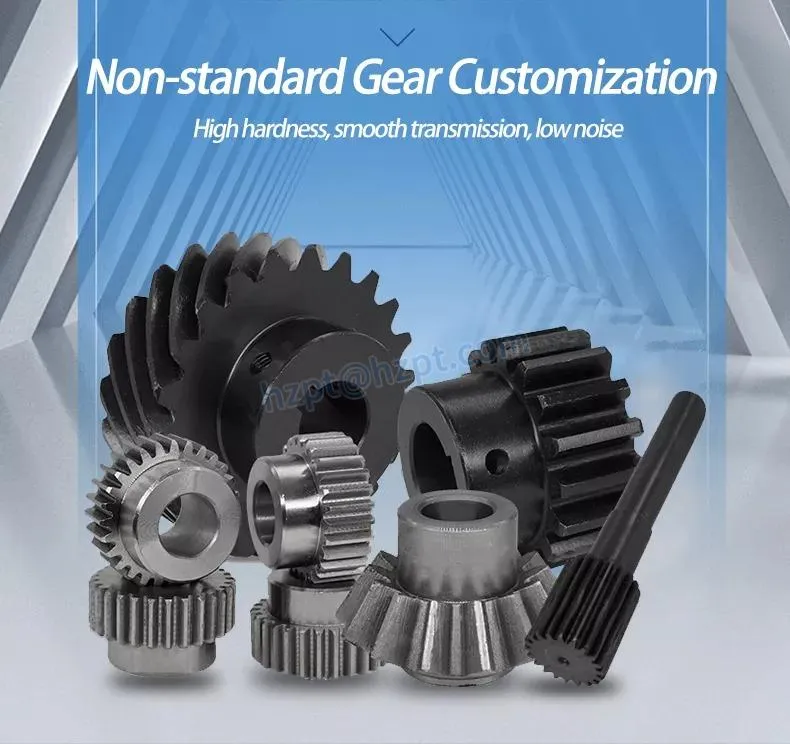
Defining the Pressure Angle: What It Actually Measures on a Bevel Gear Tooth
The pressure angle of a bevel gear — designated αₙ (normal pressure angle) in ISO 23509 and AGMA 2003 — is the angle between the tooth flank’s normal direction and the tangential direction at the pitch point, measured specifically in the normal plane perpendicular to the tooth direction. This is a critical distinction: for spur gears, the pressure angle is measured in the transverse plane. For bevel gears, because tooth proportions taper continuously from the outer end (heel) toward the inner end (toe) of the face width, the normal plane definition gives a consistent, geometry-independent value that holds across the entire face width regardless of module, pitch cone angle, or face width.
Physically, the pressure angle defines the direction along which the mating tooth flanks push against each other at the contact point. Imagine the contact force as a vector pointing from one tooth flank to the other. The angle that vector makes with the line tangent to the pitch circle at the contact point — that is the pressure angle. A larger pressure angle means the force vector tilts further away from the tangential direction, producing a larger separating component (pushing the two gears apart) and a smaller tangential component (driving rotation). This trade-off is at the heart of why pressure angle selection matters so much in gear engineering.
Normal Pressure Angle vs Transverse Pressure Angle in Spiral Bevel Gears
For straight bevel gears, the normal and transverse pressure angles are equal, because the tooth direction is exactly radial — there is no helix or spiral angle to create a plane difference. For spiral bevel gears and zerol bevel gears, the tooth curves at a spiral angle (typically 25–35°), which means the transverse pressure angle (αt) and the normal pressure angle (αₙ) differ by the relationship: tan(αt) = tan(αₙ) / cos(βm), where βm is the mean spiral angle. Manufacturing practice for spiral bevel gears specifies the normal pressure angle on the cutting tool setup, so αₙ is the specified value in all technical drawings and standards. For hypoid bevel gears, the situation is further complicated by the hypoid offset — ISO 23509 Section 9 provides the complete calculation that accounts for the offset’s effect on the effective pressure angle at the pitch point.
Standard Pressure Angle Values and When to Choose Each One
Four pressure angle values are in active use in bevel gear design across Australian industry. Understanding when each is appropriate prevents one of the most common and costly specification errors in gear procurement — ordering a replacement gear at 20° when the original was 25°, or specifying 14.5° for a new design where 20° is now the industry standard. The following table and discussion cover every practical case.
The 14.5° pressure angle dates from early 20th-century gear cutting practice and appears only on older equipment. For any new design, 14.5° offers no advantage over 20° and several disadvantages — lower Hertz contact stress capacity, higher sensitivity to contact ratio loss from profile errors, and no current cutting tool standard support for new production. If you encounter a 14.5° bevel gear in existing equipment, replace it with 14.5° for an exact match, but never specify it for a new drive. The 22.5° and 25° angles demand closer attention to bearing selection, because the higher radial separating force significantly loads shaft bearings — taper roller bearing pairs on both shafts, with calculated preload, are mandatory at 25° for any industrial application.
How Pressure Angle Governs the Force Triangle in Bevel Gear Meshing
The tooth force in a bevel gear mesh resolves into three components, and the pressure angle directly controls two of them. This is not an academic detail — it is the engineering reason why getting the pressure angle right matters to every bearing in the gearbox, not just the gear teeth themselves. The three force components acting on the driving pinion are defined as follows for a standard 90° shaft angle drive:
WT = 2T₁ / dm1Drives rotation; proportional to transmitted torque T₁ and inversely proportional to mean pitch diameter dm1. Not directly affected by pressure angle.
WR = WT × tan(αₙ) × cos(δ₁)Pushes gears apart radially. Loads shaft bearings radially. Increases with higher pressure angle. δ₁ = pinion pitch cone angle.
WA = WT × tan(αₙ) × sin(δ₁)Acts along shaft axis. Loads taper roller bearings axially. Direction reverses if rotation reverses. Must be resisted by bearing arrangement.
Note: For spiral bevel gears, additional axial and radial force components from the spiral angle β must be added vectorially to the above. The net axial force can be additive or subtractive depending on the hand of spiral and the direction of rotation. ISO 23509 Annex C provides the complete force component equations for spiral bevel gears.
Worked Example: How Pressure Angle Affects Bearing Load
Scenario: Conveyor head drive bevel gear. Pinion input torque T₁ = 450 N·m. Mean pitch diameter dm1 = 62 mm. Pitch cone angle δ₁ = 20°. Compare bearing loads at αₙ = 20° vs αₙ = 25°.
WT = 2×450,000/62 = 14,516 N
WR = 14,516×tan(20°)×cos(20°) = 4,977 N
WA = 14,516×tan(20°)×sin(20°) = 1,812 N
WT = 14,516 N (same)
WR = 14,516×tan(25°)×cos(20°) = 6,376 N (+28%)
WA = 14,516×tan(25°)×sin(20°) = 2,321 N (+28%)
Moving from 20° to 25° pressure angle increases bearing radial and axial loads by 28% for the same transmitted torque. Bearings and shaft must be designed to accommodate this — but in exchange, the Hertz contact stress capacity of the tooth flanks increases by approximately 15–20%, significantly extending gear life under high-load conditions.
Pressure Angle and Transmission Efficiency: Setting the Record Straight
A common misconception circulating in Australian engineering practice is that a higher pressure angle significantly reduces bevel gear drive efficiency. This misunderstanding often causes engineers to default to 20° even when the application clearly demands 25°, accepting shorter gear life in exchange for a negligible efficiency gain. The reality is more nuanced and, for most industrial bevel gear applications, the efficiency impact of pressure angle selection is far smaller than most engineers expect.
Bevel gear mesh efficiency depends on three loss components: (1) sliding friction between tooth flanks at positions away from the pitch line; (2) rolling friction at the pitch line contact; and (3) churning losses from oil agitation in the housing. Of these, only component (1) is meaningfully influenced by pressure angle, and the effect is small. A higher pressure angle shifts the contact point geometry and slightly increases the total path of contact, but the change in sliding velocity — which drives friction loss — between 20° and 25° is typically less than 3–5% of total sliding velocity. For a well-lubricated bevel gear drive operating in the industrial temperature range, this translates to an efficiency difference of 0.2–0.4% at most. In practical terms: if your drive operates at 95.5% efficiency at 20° pressure angle, it will operate at approximately 95.1–95.3% at 25°. The difference is unmeasurable in normal industrial practice.
What pressure angle does change substantially is the life efficiency of the drive — meaning how long the gear set operates before requiring replacement. A 25° pressure angle gear set in a mining crusher application may last 4–6 times as long as a 20° set under the same load, because the higher contact stress capacity keeps the tooth flanks below their pitting fatigue threshold. The reduced maintenance downtime and replacement part cost vastly outweigh any theoretical reduction in instantaneous mechanical efficiency.
How Pressure Angle Is Realised in Bevel Gear Manufacturing
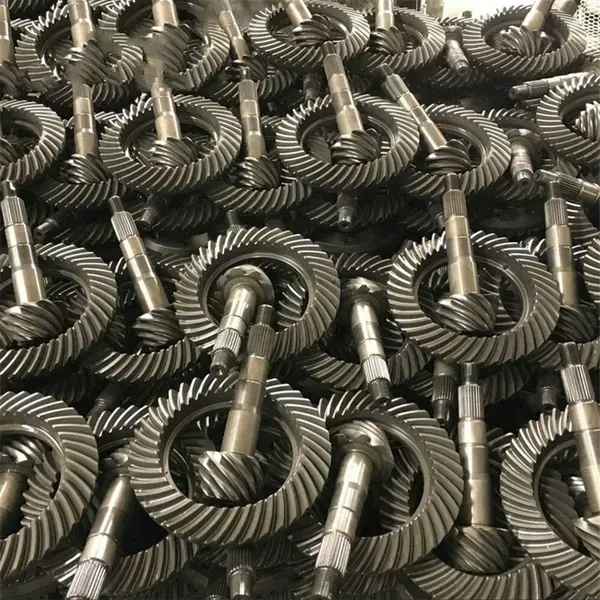
The pressure angle is not simply a number on a drawing — it is a physical setting built into the cutting tool geometry and machine setup for every bevel gear cutting operation. Understanding the manufacturing process helps engineers appreciate why ordering a non-standard pressure angle is not simply a software change, but requires specific tooling.
Step 1: Tool Selection
For straight bevel gears, the pressure angle is ground into the cutting face of the form milling cutter or the bevel gear generator cutter. Standard cutters are produced at 14.5°, 20°, and 25°. Non-standard pressure angles require special-order tooling with longer lead times.
Step 2: Machine Setup
On a Gleason or Klingelnberg bevel gear generator, the cradle angle and tilt angle settings are calculated from the pressure angle, spiral angle, and pitch cone angle. Machine setup sheets include the pressure angle as a primary parameter for all other settings.
Step 3: Profile Inspection
The cut tooth profile is verified by CMM measurement of the normal tooth section. The measured pressure angle (from the profile slope at the pitch circle) must match the specified value within the tolerance of the specified gear quality grade (ISO 1328 or AGMA 390).
Step 4: Contact Pattern Verification
Mating gears are run together under light load with marking compound to verify contact pattern position and coverage. A correct pressure angle produces a central, elliptical contact pattern. An error shifts the contact toward the tooth tip (too low) or root (too high).
Pressure Angle Selection by Industry and Application in Australia
Different Australian industries impose different duty cycles, load types, and operating environments on their bevel gear drives — which translates directly into different pressure angle requirements. Specifying the same 20° standard pressure angle for a robotics joint actuator and a WA iron ore conveyor head drive is a mistake in at least one of those applications. The following industry-specific guidance reflects the approach Australia Ever-Power applies to every custom bevel gear design review.
Mining & Resources (WA, QLD, NSW)
Recommended: 25°
Conveyor drives, crusher drives, and dragline components operate under continuous high torque with regular impact and stall-load events. The higher contact stress capacity of 25° directly addresses the pitting fatigue mode that dominates failure in these applications. Material: 18CrNiMo7-6, HRC 58–62.
Agriculture (All States)
Recommended: 20°
PTO drives and header right-angle gearboxes generally operate at moderate loads with seasonal use patterns. The standard 20° provides adequate life when the module is correctly sized for stall-load conditions. Replace with 22.5° if field jamming and stall events are frequent.
Robotics & Automation (VIC, NSW, QLD)
Recommended: 20°
Compact joint drives in industrial robots prioritise low backlash and smooth meshing over maximum load capacity. 20° with ground tooth profile (ISO quality 5–6) and fine module (m=1–3) is the correct combination. Higher pressure angles increase noise and backlash variation in precision applications.
Marine & Offshore (QLD, NSW, WA)
Recommended: 20°–22.5°
Steering gear bevel drives and thruster right-angle gearboxes are typically hypoid types. 20° is standard for most marine steering applications; 22.5° for higher-torque azimuth thruster drives. Marine grades require corrosion-resistant material and IP66/68 sealing specification.
Solar Tracking (SA, VIC, NSW, QLD)
Recommended: 20°
Single-axis and dual-axis tracker drives use non-standard shaft angles (60–75°) and low-to-moderate torques. 20° pressure angle at the correct module and non-standard pitch cone angle provides adequate life for Australian solar farm duty cycles. The shaft angle non-standard requirement is far more specification-critical than pressure angle for these drives.
Construction & Bulk Handling (National)
Recommended: 20°–25°
Crane slewing drives and skip hoist drives see intermittent high loads and start-stop duty. The correct choice depends on peak-to-nominal torque ratio. If peak torque exceeds 2.5× nominal during starting or braking, 25° is justified. Material: 20CrMnTi minimum; 17NiCrMo6 for higher loads.
Related Components That Must Be Specified Alongside Pressure Angle
Changing the pressure angle of a bevel gear does not affect just the gear teeth — it changes the load on every surrounding component. When specifying pressure angle for a new design or replacement gear, the following components must be reviewed in parallel:
- Taper Roller Bearings: Higher pressure angle means higher axial and radial bearing loads. When upgrading from 20° to 25° on an existing drive, verify bearing dynamic load ratings against the new force components. At 25° with high gear ratios, the pinion-side bearing is almost always the life-limiting component.
- Shaft Diameter and Material: Higher separating force increases bending moment in the shaft between the gear hub and the outboard bearing. Recalculate shaft bending stress if pressure angle changes significantly. For 25° PA, minimum shaft diameter typically increases 10–15% over the 20° equivalent for the same torque.
- Gear Housing Stiffness: A stiffer housing maintains the shaft angle under higher separating loads, protecting the tooth contact pattern. If upgrading a standard housing from 20° to 25° PA gears, assess whether housing distortion under the increased force could degrade contact quality.
- Gear Oil Grade: Higher contact stress from elevated load capacity at 25° generates more heat at the tooth contact. Review oil viscosity and EP additive specification when upgrading to higher pressure angle gears, particularly for hypoid bevel applications where sliding is inherently high.
- Torque-Limiting Coupling: For drives where shock or stall loading is the primary reason for upgrading to a higher pressure angle, a torque-limiting coupling should be evaluated as an alternative or complementary solution. Set slip torque at 1.5–2× nominal to protect both the gear and the bearings.
- Shimming and Axial Setting Kit: Different pressure angles may produce slightly different tooth crown dimensions, affecting the axial setting procedure. Always obtain updated axial setting instructions from Australia Ever-Power when replacing gears with a different pressure angle, even if shaft angle and module remain the same.
Sustainability and Compliance: Pressure Angle in the Context of Australian Industry Standards
Australia’s mining, agricultural, and renewable energy sectors operate under increasing ESG and regulatory scrutiny. The connection between correct pressure angle selection and sustainability is direct but often overlooked: a correctly specified 25° pressure angle bevel gear in a mining application that achieves 4× the service life of an undersized 20° gear eliminates three replacement cycles — each of which involves manufacturing energy, material consumption, shipping emissions from China to Australia, and maintenance downtime that requires additional fuel consumption from maintenance vehicles and equipment. Over a ten-year mine operating period, the embodied energy difference between correct and incorrect gear specification for a fleet of 50 conveyor drives is substantial and quantifiable for ESG reporting purposes.
Australia Ever-Power supports Australian companies’ compliance requirements through ISO 683-17 material traceability (full mill certificate from melt to finished gear), RoHS and REACH compliant material selection for robotics and marine applications, and supply chain documentation suitable for AusTender-registered procurement frameworks. For renewable energy project developers requiring carbon footprint documentation for equipment supply chains, extended gear life data and material certificates are available as standard order documentation.
Market Price Comparison: Bevel Gears by Pressure Angle Specification
All prices AUD ex-GST, indicative only. Contact [email protected] for specific quotation.
Australia Ever-Power vs Other Suppliers: Pressure Angle Flexibility
What Australian Engineers Say About Getting Pressure Angle Right
“We had been replacing bevel gear pairs every eight months on our crusher feed conveyor in the Pilbara. Australia Ever-Power looked at our application data, confirmed we were running a 20° PA gear under a load profile that clearly needed 25°, and supplied a matched replacement set in 25° with 18CrNiMo7-6 material. Eighteen months later that gear is still running. Best single specification decision I made that year.”
“For our robot joint bevel drives I needed low backlash at 20° PA with ground profile — pretty specific, and most suppliers just wanted to give me whatever they had in stock. Australia Ever-Power quoted exactly what I asked for, provided a CMM profile report with the delivery, and the contact pattern on every pair matched the drawing. That is all I need from a gear supplier.”
“Our original supplier for our crane slewing drive bevel gears could only supply 20°. We upgraded to 22.5° on the Australia Ever-Power recommendation when we redesigned the drive for a heavier lift rating. The bearing loads worked out practically the same as our old 20° design because we also reduced module slightly — which Australia Ever-Power’s engineer suggested as a trade-off I hadn’t considered. That level of system thinking is what separates a specialist gear supplier from a parts catalogue.”
“I sent photos of a failed bevel gear pair from our irrigation pivot gearbox and asked for a root-cause assessment. The reply correctly identified that the pitting pattern was consistent with 20° pressure angle under an overload caused by a seized pivot tower — not a material or manufacturing issue. That diagnosis saved me from ordering the same spec again and repeating the failure. Four stars because I’d like an online enquiry portal, but the technical quality of the response was exactly what was needed.”
Frequently Asked Questions — Bevel Gear Pressure Angle
Need Custom Bevel Gears at Any Pressure Angle?
14.5° · 20° · 22.5° · 25° · Custom specification · ISO 23509 calculation · 48hr DFM review
Australia Ever-Power | 27 Harley Crescent, Condell Park NSW 2200 | [email protected]