
Load capacity failures account for nearly 35% of unplanned bevel gear replacements in Australian mining, agricultural, and industrial operations — and the majority are preventable. Gear load capacity is not fixed by tooth size alone; it is the combined result of material selection, heat treatment depth and hardness, tooth geometry, and surface finish. Every one of these variables can be systematically improved to increase allowable transmitted torque without changing outer dimensions. This guide works through every practical lever available to an engineer seeking to raise bevel gear load capacity — from alloy steel upgrades through surface engineering treatments, with worked cost-benefit benchmarks relevant to Australian industry.
Two Independent Failure Modes: Bending and Contact
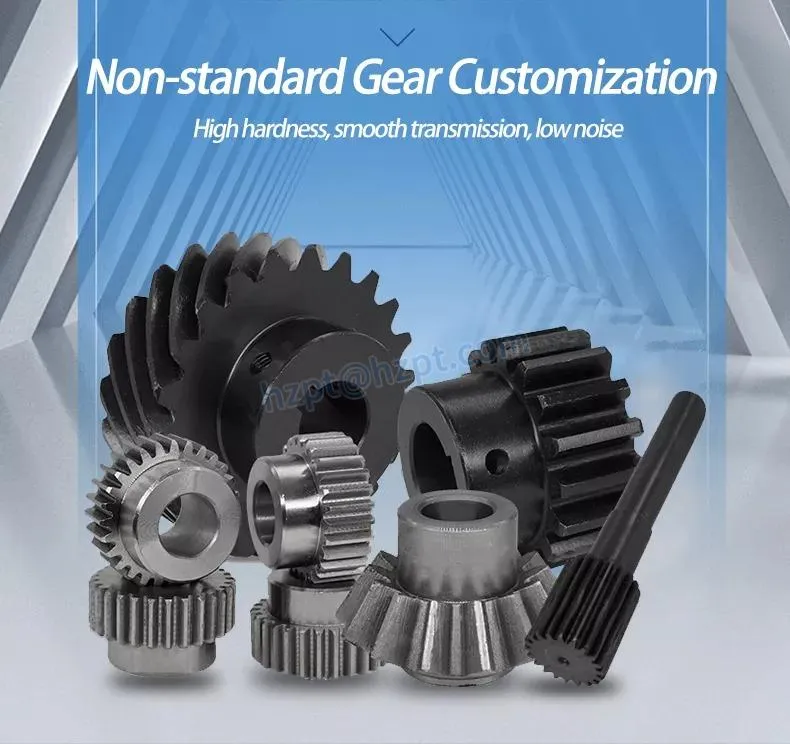
Every bevel gear tooth has two independent failure modes that set its load capacity ceiling, governed by different material properties and requiring different improvement strategies. Understanding which limit governs your specific application is the prerequisite for choosing the right path.
Tooth Root Bending Fatigue
Bending fatigue initiates at the tooth root fillet — the curved junction between the flank and gear blank — where stress concentration is highest under applied load. The crack propagates transversely until the tooth fractures, and debris rapidly destroys remaining teeth. Bending capacity is governed by the material’s fatigue endurance limit, case depth at the root (for case-hardened gears), root fillet radius, and surface roughness at the root. Per ISO 6336 Part 3, permissible root bending stress for carburised 20CrMnTi is approximately 430–500 MPa versus only 250–280 MPa for through-hardened C45 steel — an 80% improvement from material selection alone.
Tooth Surface Contact Fatigue (Pitting)
Contact fatigue occurs at the tooth flank where repeated Hertzian contact cycles cause subsurface crack initiation, eventually producing crater-shaped pitting. Contact capacity is governed by surface hardness, case depth (the hardened zone must contain the subsurface shear stress peak), surface roughness (smoother surfaces support thicker lubricant films), and lubricant film thickness. Both limits must be calculated independently per ISO 6336, and the lower-capacity mode governs the design rating.
Material Upgrade Paths: Capacity vs Cost
Material selection is typically the highest single-step return available. Upgrading alloy steel grade — without any dimensional change — can increase permissible tooth root bending stress by 30–50% and contact stress by 20–35%. The table below benchmarks common upgrade paths for Australian industrial bevel gear applications.
Heat Treatment Optimisation: Case Depth and Hardness Profile
Getting Case Depth Right
Case depth is the most frequently under-specified parameter in bevel gear heat treatment, yet its effect on load capacity is disproportionate. For carburised gears, the effective case depth must be sufficient that the maximum subsurface shear stress — occurring at approximately 0.4–0.6 × Hertzian contact half-width below the surface — falls within the hardened case, not in the softer core. Insufficient case depth produces sub-surface spalling failure rather than surface pitting.
A practical guide from ISO 6336-5: effective case depth at the tooth root (mm) ≈ 0.15–0.25 × module for medium loads, and 0.25–0.35 × module for high loads. An M6 bevel gear at high load requires minimum 1.5–2.1 mm case depth — a specification that must be explicitly stated on the drawing and verified by destructive cross-section testing on a sample gear from each production batch.
Core Toughness: The Other Side of the Trade-off
The ideal case-hardened bevel gear has a very hard case (58–62 HRC for carburised 20CrMnTi) over a tough lower-hardness core (30–42 HRC). The core absorbs shock loads that the hard case cannot — if the core is also hard, the gear becomes brittle and prone to sudden fracture rather than progressive fatigue failure. Correct tempering at 160–180°C after quenching maintains core tensile strength of ~1,100 MPa while preserving adequate toughness for Australian mining and agricultural shock-load applications. Always verify core hardness separately from case hardness in the inspection certificate.
Geometric Improvements: Module, Face Width, Spiral Tooth, and Root Fillet
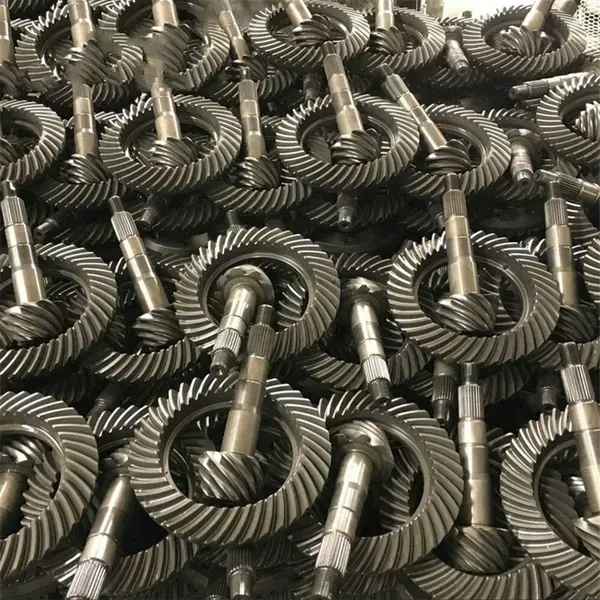
When material and heat treatment options are exhausted or cost-constrained, geometric modifications offer additional load capacity without changing housing dimensions significantly.
Surface Engineering for Maximum Contact Capacity
Isotropic Superfinishing (ISF)
ISF reduces tooth flank Ra from 0.8 µm (ground) to 0.1–0.2 µm via chemically accelerated vibratory processing. The ultra-smooth surface supports EHL lubricant films 4–8× thicker than a conventionally ground flank, effectively raising the lambda ratio above 2.0 (full EHL film) — where surface-initiated contact fatigue essentially stops. Australian wind turbine O&M teams specifying ISF-finished bevel sets report zero measurable wear metal trend through 18–24 months of condition monitoring data.
Manganese Phosphate Coating
Manganese phosphate provides a micro-porous surface that retains lubricant between crystalline platelets during the initial running-in period, preventing scuffing when tooth surfaces are not yet mutually conformed. Applied before first operation, it reduces commissioning scuffing failure rate by approximately 60–70%. Particularly valuable on Australian mining equipment where full load is applied before running-in is complete.
Cumulative Capacity Stack: What Each Improvement Adds
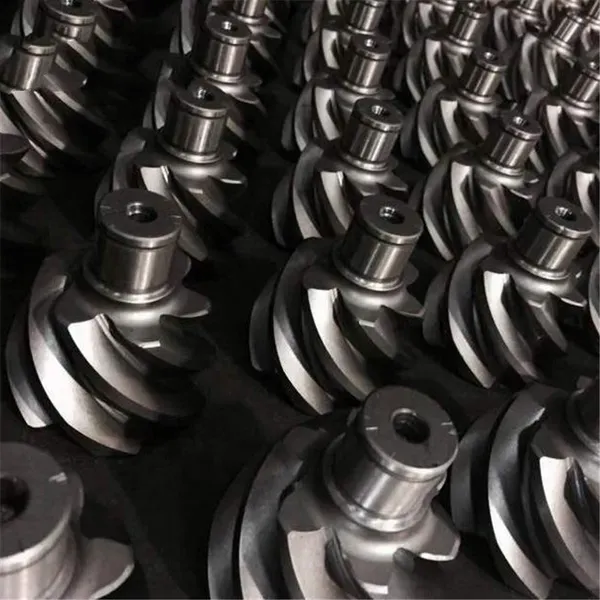
Industry Applications Where Load Capacity Is Critical
⛏️ Mining — WA & QLD
Haul truck differentials, conveyor head drives, and crusher bevel heads operate 24/7 under severe shock loading. 20CrMnTi carburised with shot-peened roots and phosphate running-in coating is the current standard for Pilbara iron ore and Bowen Basin coal bevel gear specifications.
🌬️ Wind Energy — SA, VIC, WA
Wind turbine nacelle bevel gears must achieve 20-year fatigue life under variable-amplitude loading. 42CrMo nitrided with ISF finishing is the emerging standard — extending calculated fatigue life from 15 to 25+ years for typical Australian wind loading profiles.
🚜 Agriculture — NSW, VIC, QLD
Harvester and tractor PTO drives must handle high instantaneous torque from ground contact shock. 40Cr induction-hardened with full-radius root fillets provides cost-effective capacity increases for Australian agricultural OEMs without forging tooling investment.
🤖 Robotics & Automation
Collaborative robot joints using bevel gear drives need maximum torque capacity within the smallest envelope. 7075-T6 aluminium with hard anodising provides the best capacity-to-weight ratio for light-duty robotic drives; 17-4PH stainless steel suits medium-duty corrosion-resistant applications.
Related Product: High-Load Spiral Bevel Gears
Australia Ever-Power’s spiral bevel gears in carburised 20CrMnTi with optional shot peening and DIN Grade 6 precision grinding represent the highest standard-production load capacity configuration available. Contact [email protected] for a full ISO 6336 load capacity review against your torque, speed, and service life requirements — provided within 48 AEST business hours.
Australia Ever-Power vs Competitors: Load Capacity Support
Customer Experiences
“We were having tooth root fractures on our conveyor head drive every 8–10 months. Australia Ever-Power recommended upgrading from C45 to 20CrMnTi carburised with shot-peened roots. We’re now 30 months past the last replacement. The calculation-backed recommendation rather than a generic upgrade was what convinced us.”
“Switching from straight to spiral bevel gears on our harvester PTO drives increased seasons between failures from two to five-plus. Exactly as predicted by the Australia Ever-Power ISO 6336 load review — a well-founded recommendation rather than a sales pitch.”
“Our ISF-finished 42CrMo nitrided spiral bevel sets for the SA wind farm show no measurable wear metal trend after 18 months of condition monitoring. Comparable performance to European-sourced turbine gears at around 55% of the import cost.”
“Our robotics joint bevel gears in 7075-T6 aluminium with hard anodise have run 14 months without failure and saved 340g per joint versus our previous steel gears — which cascades directly into faster cycle times from lower arm inertia.”
Frequently Asked Questions
Optimise Your Bevel Gear Load Capacity with Australia Ever-Power
27 Harley Crescent, Condell Park NSW 2200 | [email protected]