
Module and tooth count are the two parameters that define a bevel gear more completely than any other — they set tooth size, gear envelope, ratio accuracy, and ultimately whether the gear set can transmit the required torque without failing within the intended service life. Yet module selection remains one of the most frequently underdone steps in gear procurement across Australian industry: engineers often default to matching whatever was installed before, without checking whether the original module was correctly sized for the actual application load. This article walks through the complete module and tooth count selection process from application requirements to final specification, with real-world worked examples for conveyor drives, agricultural PTO gearboxes, and robotics joint actuators.
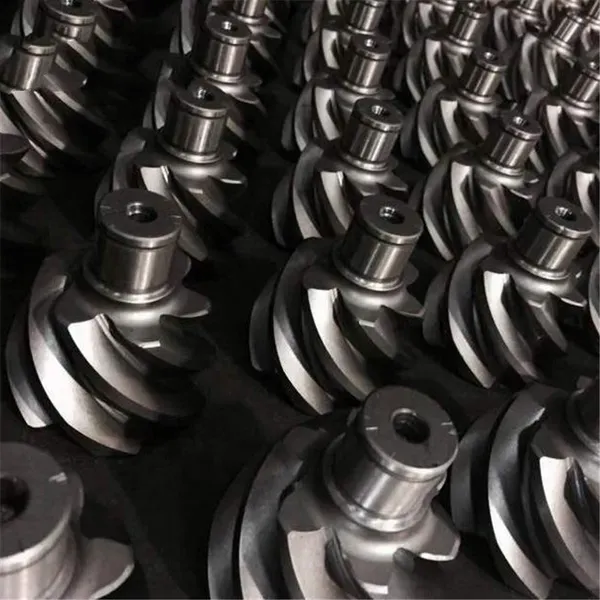
What Module Actually Means on a Bevel Gear — and Why It Cannot Be Chosen Arbitrarily
Module (m) is defined as the pitch diameter divided by the tooth count: m = d / z. In bevel gears, because the pitch diameter varies continuously from the heel (outer end) to the toe (inner end) along the face width as the gear tapers toward the cone apex, module is always specified at the outer pitch diameter (the large end of the cone): m = d_e / z, where d_e is the outer pitch diameter. This is the module value you will see on every bevel gear drawing, specification sheet, and cutting tool order. The mean pitch diameter at the mid-face is d_m = d_e − b×sin(δ), and the mean module is m_m = m × (1 − b/(2R)) — used in load capacity calculations but not specified on drawings.
Module sets the physical size of each tooth. A larger module means bigger teeth — more material in each tooth, deeper root, wider flank, higher load-carrying capacity per tooth. But larger module also means fewer teeth fit on the same pitch circle diameter, which directly affects the gear ratio accuracy achievable with integer tooth counts, and increases the minimum pinion tooth count needed to avoid undercut. Module selection is therefore never a single-variable optimisation — it involves balancing load capacity, gear envelope, ratio accuracy, tooth count constraints, and manufacturing cost simultaneously.
ISO Standard Module Series and What “Non-Standard Module” Costs You
ISO 54 defines the standard module series for gear cutting tools and gear inspection standards. For bevel gears, the applicable standard modules from ISO 54 are:
Standard modules (ISO 54, preferred series):
1 · 1.25 · 1.5 · 2 · 2.5 · 3 · 4 · 5 · 6 · 8 · 10 · 12 · 16 · 20 (mm)
Second preference (avoid if possible): 1.125 · 1.375 · 1.75 · 2.25 · 2.75 · 3.5 · 4.5 · 5.5 · 7 · 9 · 11 · 14 · 18
A non-standard module — for example, m = 3.75 or m = 6.5 — requires special-order cutting tools that are not held in stock at most gear manufacturers. This adds lead time (typically 4–8 weeks for special tooling versus immediate availability for standard modules) and a significant tooling cost premium (AUD $500–$3,000 per cutter set depending on size). It also prevents future repeat orders from a different supplier without re-tooling. Unless interchangeability with an existing non-standard module drive is required for replacement purposes, always specify from the ISO standard series.
The Complete Module Selection Process: Four Steps from Application Data to Final Specification
The following process is the methodology Australia Ever-Power’s engineering team applies to every custom bevel gear design review. It is based on the ISO 10300 load capacity calculation framework with the Lewis bending estimate used as the initial sizing tool, refined by contact stress check and geometry constraints before final specification.
Collect Application Data
Required inputs: Pinion torque T₁ (N·m), shaft angle Σ (°), gear ratio i = z₂/z₁, operating speed n₁ (RPM), duty cycle, application factor k_a (see table), material σ_b_allow (MPa), and any envelope constraints (max outer diameter, max face width).
Initial Module Estimate (Lewis Method)
Apply the Lewis bending stress estimate to find minimum module. Assume z₁ (start with 16–20 for most applications), estimate Lewis form factor Y from virtual tooth count, assume b/m ratio of 8–10, calculate m_min, then round up to next ISO standard module.
Select Tooth Counts
Choose z₁ and z₂ satisfying: (a) z₂/z₁ ≈ target ratio, (b) z₁ ≥ z_min (typically 15–18 for 20° PA), (c) GCD(z₁, z₂) = 1 or as small as possible (hunting tooth condition), (d) ratio error ≤ 2% from target for most industrial applications.
Verify Geometry and Contact Stress
Calculate outer diameter d_e = m×z, cone distance R = d_e1/(2×sin δ₁), face width b (target 0.3R, max min(R/3, 10m)). Perform contact stress check per ISO 10300-2. If contact stress exceeds allowable, increment module by one step and repeat from step 3.
Key Formulas: Module, Tooth Count, and Geometry from First Principles
All bevel gear geometry calculations begin with module and tooth count. The following formulas form the complete toolkit for outer geometry calculation in accordance with ISO 23509, applicable to straight bevel gears, spiral bevel gears, and zerol bevel gears at any shaft angle.
tan(δ₁) = z₁/z₂ → δ₁ = arctan(z₁/z₂)δ₂ = 90° − δ₁d_e1 = m × z₁d_e2 = m × z₂R = d_e1 / (2 × sin δ₁) = d_e2 / (2 × sin δ₂)b_target = 0.30 × R (max: min(R/3, 10m))h_a = 1.000 × m (addendum)h_f = 1.188 × m + 0.05 (dedendum, with clearance)h = h_a + h_f = 2.188m + 0.05 (whole depth)d_m = d_e − b × sin(δ) (mean pitch diameter)m_m = m × (1 − b/(2R)) (mean module)z_v1 = z₁ / cos(δ₁) (virtual pinion tooth count)z_v2 = z₂ / cos(δ₂) (used for Lewis Y factor lookup)Tooth Count Selection: Ratio, Undercut, and the Hunting Tooth Requirement Explained
Tooth count selection for a bevel gear pair must satisfy three independent engineering constraints simultaneously. Many engineers are aware of the gear ratio requirement but underestimate the practical significance of the other two — undercut avoidance and the hunting tooth condition. Getting either of these wrong produces a gear pair that either fails early from bending fatigue (undercut) or wears unevenly with recurring hotspot damage at a few teeth (no hunting tooth).
Constraint 1: Gear Ratio from Integer Tooth Counts
The target gear ratio i = n₁/n₂ = z₂/z₁ must be realised with integer tooth counts. Since z₂ and z₁ must both be whole numbers, the achievable ratio is always a rational fraction — which may not exactly equal the target decimal ratio. The acceptable ratio error for most industrial applications is ±2% from the nominal target. Precision index drives and synchronised machinery (packaging lines, textile machinery, printing presses) may need ±0.5% or tighter. To find integer tooth count combinations within tolerance, set z₁ to a practical value (15–25 for most applications) and calculate z₂ = round(z₁ × i), then verify the actual ratio and ratio error. Iterate z₁ upward until GCD(z₁, z₂) = 1 is also satisfied.
Constraint 2: Minimum Tooth Count to Avoid Undercut
Constraint 3: The Hunting Tooth Condition
When GCD(z₁, z₂) > 1, every tooth on the pinion always contacts the same set of gear teeth — it never “hunts” through all the gear teeth. If those gear teeth have a slightly different surface finish, a pitch error at that location, or a minor hardness variation, the same pinion tooth contacts that same defective gear tooth on every revolution, concentrating wear at one spot. Over thousands of cycles this creates a distinctive localised wear pattern and eventually a stress concentration that leads to early fatigue failure. The solution is to ensure GCD(z₁, z₂) = 1, meaning the smallest common factor between the two tooth counts is 1. This guarantees every pinion tooth contacts every gear tooth in turn, distributing wear uniformly.
⚠️ Common Mistake: z₁ = 18, z₂ = 54 for a 3:1 ratio. GCD(18, 54) = 18 — very poor, only 3 unique contact combinations. Fix: z₁ = 19, z₂ = 58 → ratio 3.053:1, GCD = 1 ✔. Or z₁ = 17, z₂ = 52 → ratio 3.059:1, GCD = 1 ✔. The small ratio deviation (1.8%) is acceptable for most conveyor applications.
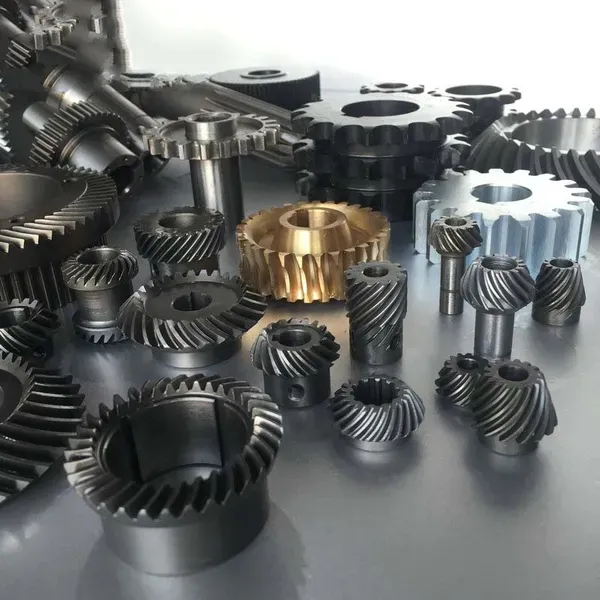
Three Worked Examples: Conveyor Drive, Agricultural PTO, and Robotics Joint
Example A — Mining Conveyor Head Drive (Heavy Duty)
Application: Conveyor head drive, coal mine, QLD. Shaft angle: 90°. Required ratio: 4:1. Pinion input torque: 820 N·m at 740 RPM. Material: 18CrNiMo7-6, σ_b_allow = 380 MPa. k_a = 1.75 (moderate shock).
m ≥ ∛[2×820,000/(18²×0.296×9×(380/1.4)×1.75)] = ∛[1,640,000/137,476] = ∛11.93 ≈ 2.29 mm → m = 4 mm (ISO)
R=76/(2×sin13.86°)=76/0.479=158.7mm. b_target=0.30×158.7=47.6mm → use 48mm. Check: b≤R/3=52.9mm ✔, b≤10m=40mm ✗ → reduce to b=40mm (governs).
Final: m=4, z₁=19, z₂=77, ratio=4.053:1, δ₁=13.86°, δ₂=76.14°, R=158.7mm, b=40mm
Example B — Agricultural PTO Gearbox (Header Drive)
Application: Grain header PTO right-angle gearbox. Shaft angle: 90°. Required ratio: 1.5:1 (speed-up). PTO input: 50 kW at 540 RPM. Torque at 540 RPM: T = 60×P/(2π×n) = 60×50,000/(2π×540) = 884 N·m. Material: 20CrMnTi, σ_b_allow = 320 MPa. k_a = 2.25 (jam/stall in harvest).
m ≥ ∛[2×884,000/(17²×0.298×8×(320/1.4)×2.25)] = ∛[1,768,000/112,403] = ∛15.73 ≈ 2.51 mm → m = 3 mm (ISO)
R=51/(2×sin34.2°)=51/1.127=45.3mm. b=0.30×45.3=13.6mm → use 14mm. Check: b≤R/3=15.1mm ✔, b≤10m=30mm ✔
Final: m=3, z₁=25, z₂=17, ratio=1.471:1, R=45.3mm, b=14mm
Example C — Robotics Joint Bevel Gear (Precision, Non-Standard Angle)
Application: Collaborative robot wrist joint. Shaft angle: 72° (non-standard). Required ratio: 2.5:1. Max outer diameter of larger gear: 45mm. Joint torque: 28 N·m at 60 RPM. Material: 20CrMnTi case-hardened, σ_b_allow = 300 MPa. k_a = 1.1 (smooth servo drive).
tan(δ₂)=0.9511/(0.309+15/38)=0.9511/0.703=1.353 → δ₂=53.51°, δ₁=72°−53.51°=18.49°
d_e1=1×15=15mm, d_e2=1×38=38mm ✔ (≤45mm). R=15/(2×sin18.49°)=15/0.634=23.7mm. b=0.30×23.7=7.1mm → use 7mm.
Final: m=1, z₁=15, z₂=38, ratio=2.533:1, Σ=72° (non-standard), δ₁=18.49°, δ₂=53.51°, R=23.7mm, b=7mm
Application Factors (k_a): How Load Type Changes the Required Module
The application factor k_a accounts for external dynamic loads beyond the nominal rated torque. It is one of the most important — and most frequently underestimated — inputs to the module sizing calculation. Using k_a = 1.0 (perfectly smooth load) for a mining crusher drive or agricultural PTO is a design error that leads to undersized gears failing in service. The following table covers the main drive type and driven machine combinations encountered in Australian industry.
Related Components Affected by Module and Tooth Count Selection
- Shaft Diameter: Outer pitch diameter d_e = m×z directly affects the minimum shaft bore diameter. Larger module increases gear hub diameter and — typically — shaft diameter requirements. Always calculate shaft stress after finalising module and tooth count.
- Taper Roller Bearings: Bearing span and bore size are set by the shaft diameter, which relates directly to the gear hub bore. After finalising module, recalculate bearing loads (W_T, W_R, W_A from Section 3) and verify L10 bearing life.
- Gear Housing Size: The cone distance R = d_e1/(2sinδ₁) sets the minimum housing bore distance between shaft centrelines. Larger module increases R, which requires a larger housing. Always check housing envelope constraints before finalising module.
- Gear Oil Volume: Larger module and cone distance require a larger housing oil volume to ensure adequate lubrication. The immersion depth of the larger gear (gear) in the oil sump should cover approximately one full tooth height — ensure the housing design provides this for the selected module.
- Torque-Limiting Coupling: The coupling slip torque setting must be referenced to the actual gear torque capacity at the finalised module. After module selection, calculate the gear bending fatigue limit torque and set the coupling slip at 1.5–2.0× nominal, but ≤ 0.9× the bending fatigue limit.
- Shimming Kit: The axial setting of bevel gears (which controls contact pattern position) is sensitive to tooth geometry that changes with module. Always obtain updated axial setting dimensions from Australia Ever-Power when module changes, even on an otherwise identical shaft angle and ratio drive.

Sustainability: Correct Module Selection Reduces Total Lifecycle Material Consumption
Module selection has a direct sustainability dimension that Australian ESG reporting frameworks are beginning to recognise. An undersized module — one that leads to premature failure after 12–18 months instead of a correctly specified 5–8 year life — multiplies the number of replacement gear sets manufactured, shipped from China to Australia, and disposed of as scrap metal over an equipment’s working life. For a fleet of 40 conveyor drive bevel gear pairs in a Queensland coal operation, the difference between a correctly specified module-5 gear set (target 6-year life) and an undersized module-4 set (actual 18-month life) represents approximately 120 replacement pairs over a 10-year operating period — or roughly 80 pairs more than needed. At approximately 12 kg of steel per pair (module 4, spiral bevel) that is nearly 960 kg of avoidable manufacturing demand per decade for one gear type alone.
Australia Ever-Power’s custom bevel gear design service explicitly includes a life and load capacity check for every order, ensuring the specified module is correctly matched to the actual application loading — not undersized for short-term price minimisation. Full material certificates per ISO 683-17, case depth reports, and CMM inspection records are provided as standard documentation to support traceability requirements under ASX ESG reporting frameworks and Government supply chain audit requirements.
Indicative Market Prices by Module — Australian Market 2025–2026
Prices AUD ex-GST, indicative only. Final price depends on quantity, shaft angle, PA, material grade, quality, and freight.
Australia Ever-Power vs Other Suppliers: Module Calculation Support
Customer Reviews: Module Selection Done Right
“Our original bevel gear pair on the conveyor head drive was module 3. After the second replacement in 14 months, I contacted Australia Ever-Power with our actual torque data. Their review said the correct module for our load and application factor was 5, not 3 — the original design was significantly undersized. The module-5 replacement has been running 28 months. That calculation service is worth more than the gear itself.”
“I needed to specify a bevel gear pair for a 72° shaft angle robot joint with a 45mm envelope constraint. Australia Ever-Power worked through the non-standard pitch cone angle calculation, confirmed module 1 was achievable within the diameter constraint, and had the gears manufactured and shipped to Melbourne in 22 days. CMM profile report included. No other supplier even quoted.”
“Our PTO header drive gearbox was failing after every harvest season. Australia Ever-Power’s review identified the tooth counts had a common factor of 17 — classic hunting tooth problem. Changed to z₁=17, z₂=44 at the same module (3) and ratio. Three harvest seasons in and the gears look almost new at the post-season inspection. I had no idea about the hunting tooth condition before that.”
“I sent through our application data for a marine thruster bevel stage — hypoid configuration, 4:1 ratio, saltwater environment. The DFM review came back with a module 6 recommendation and a note that ISO 23509 Section 9 procedure was used for the hypoid offset calculation, which I couldn’t have done myself. Delivered in 24 days. Only four stars because hypoid pricing is at the premium end — but that is the market, not the supplier.”
Frequently Asked Questions — Bevel Gear Module and Tooth Count
Specify the Right Module and Tooth Count — First Time
Lewis + ISO 10300 calculation · Hunting tooth review · ISO 23509 geometry · Non-standard shaft angles
Australia Ever-Power | 27 Harley Crescent, Condell Park NSW 2200 | [email protected]