
Material selection is the single decision that most determines whether a bevel gear set runs reliably for 200,000 km in a truck differential or fails within three months on a mining conveyor. The wrong material does not just cost money to replace — it costs downtime, safety incidents, and engineering credibility. This guide walks through every material option for bevel gears — from carbon steel to engineering polymers — with honest performance data, cost benchmarks, and the specific conditions under which each choice makes engineering sense for Australian industrial applications.
Why Material Choice Matters More Than Gear Geometry
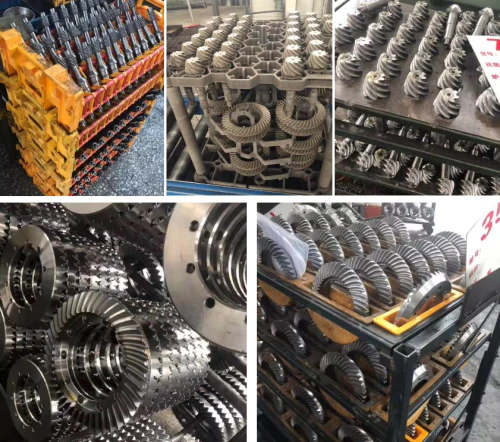
Most gear engineers spend considerable time optimising tooth profile, module, and pressure angle — and comparatively little time interrogating material selection. Yet tooth root fatigue strength, surface hardness, and temperature resistance are all fundamentally material properties. A perfectly designed spiral bevel gear in the wrong steel will fail faster than a nominally adequate straight bevel gear in the right alloy.
The key material properties governing bevel gear performance are: tensile strength (determines the gear’s resistance to bending fracture), surface hardness after heat treatment (governs pitting resistance), core toughness (governs impact resistance in shock-load applications), fatigue endurance limit (determines service life in cyclic loading), and corrosion resistance (determines suitability for wet, chemical, or marine environments).
For Australian operators across mining, agriculture, marine, and food processing, each of these properties maps directly to operational conditions that vary significantly between sectors. A harvester PTO gear has entirely different material requirements from a wind turbine nacelle bevel set or a pharmaceutical packaging drive gear — despite all three being “bevel gears” by geometric classification.
Alloy Steel: The Workhorse for High-Load Applications
20CrMnTi — The Automotive and Mining Standard
20CrMnTi is the alloy steel specified for the largest share of high-duty bevel gear applications globally, and it dominates Australian automotive differential and mining drive procurement for good reason. After carburising and quenching, it achieves a surface hardness of 58–62 HRC with a case depth of 0.8–1.6 mm, over a core with tensile strength of 1,080 MPa and impact toughness above 80 J. The result is a gear surface that resists pitting and wear while the core beneath absorbs shock loads — the ideal combination for vehicle differentials and conveyor drives.
The chromium-manganese-titanium alloying elements work together: chromium improves hardenability and corrosion resistance marginally; manganese increases hardenability and austenite grain refinement; titanium refines grain size and prevents decarburisation during carburising. The result is consistent case quality across the tooth face — critical for spiral bevel gears where the contact patch must remain within the designed zone throughout the gear’s service life.
42CrMo — Wind Energy and Heavy Industrial
42CrMo is the preferred choice where fatigue life under variable amplitude loading — rather than peak contact stress — governs the design life. Wind turbine nacelle gearboxes operating for 20+ years under stochastic wind loading are the prime example. After quenching and tempering to 280–320 HB, or nitriding to achieve a surface hardness of 62–68 HRC with a diffusion depth of 0.3–0.6 mm, 42CrMo provides a fatigue endurance limit approximately 15% higher than C45 steel of equivalent hardness. Its lower distortion during nitriding compared to carburising-grade steels also means tighter post-heat-treatment dimensional control — an important consideration for spiral bevel gears where tooth contact pattern geometry must be preserved.
Stainless Steel: When Corrosion Resistance Is Non-Negotiable
316L austenitic stainless steel and 17-4PH precipitation hardening stainless are the two grades most commonly specified for bevel gears in corrosion-critical environments. The distinction matters: 316L provides excellent corrosion resistance (including crevice corrosion in chloride environments — directly relevant for coastal installations in Sydney, Brisbane, and Darwin) but is limited to 20–35 HRC after nitriding. 17-4PH achieves 40–44 HRC in the H900 condition, providing significantly higher wear resistance while retaining adequate corrosion resistance for food-contact and marine applications.
For Australian food processing plants operating under FSANZ regulations, 316L is the default material of choice. The combination of FDA 21 CFR 177 compliance, autoclave or CIP wash-down compatibility, and adequate strength for the moderate load levels typical of filling machine and conveyor drives makes it the practical specification. Where load levels are higher — such as in marine propulsion auxiliary drives on offshore support vessels — 17-4PH provides the necessary hardness while maintaining the corrosion resistance that saltwater service demands.
One consideration specific to Australian conditions: the UV exposure and thermal cycling experienced by outdoor equipment in Queensland and Western Australia accelerates surface oxide formation on standard stainless grades. Passivation treatment (per ASTM A967) following machining is recommended to ensure the passive chromium oxide film is fully developed before the gear enters service.
Comprehensive Material Performance & Cost Comparison
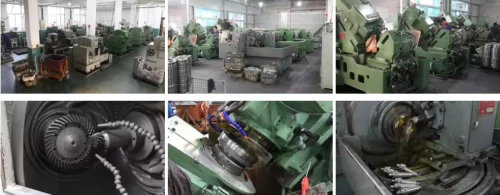
The table below consolidates the key performance parameters and indicative cost multipliers for all major bevel gear materials. Cost multiplier uses C45 carbon steel as the baseline (1.0×). All strength values are post-heat-treatment unless noted.
Non-Ferrous Metals: Brass, Aluminium, and Bronze
Non-ferrous metals occupy a distinct performance niche in bevel gear applications — they are not substitutes for steel in high-load drives, but in their correct application domain they offer advantages that steel cannot match. Understanding where the boundaries of that domain lie prevents the common mistake of specifying non-ferrous gears in applications that will stress them beyond their capability.
Brass
Brass (particularly C36000 free-machining brass) is specified for light-duty instrument drives, solar tracking mechanisms, and laboratory automation equipment where low-speed, low-load operation in a potentially corrosive environment is the defining condition. Its machinability index of approximately 100% (compared to 45–55% for carbon steel) significantly reduces machining cost, making it cost-competitive for small-batch precision gears despite its higher base material cost. The key limitation is fatigue strength — brass should not be specified above approximately 50 N·m transmitted torque at the gear mesh.
Aluminium Alloy
7075-T6 aluminium alloy is increasingly specified for bevel gears in weight-critical applications — powered prosthetics, exoskeleton joints, aerospace ground support equipment, and racing vehicle differentials — where the 5.5× density advantage over steel (2.81 vs 7.85 g/cm³) directly reduces inertia and operating loads. Hard anodising to 40–70 µm depth increases surface hardness to approximately 500 HV, providing acceptable wear resistance for moderate-load, moderate-speed applications. The critical limitation is operating temperature: aluminium alloys soften significantly above 150°C, making them unsuitable for drives where gear housing temperatures regularly exceed this threshold.
Engineering Polymers: POM, Nylon, and PEEK
Engineering polymers occupy the low-load end of the bevel gear material spectrum, but within their operating envelope they deliver advantages that no metallic material can replicate: inherent self-lubrication, immunity to corrosion, electrical non-conductivity, and the ability to absorb vibration and reduce transmitted noise by 5–12 dB(A) versus equivalent steel gears. For Australian food processing, pharmaceutical packaging, and laboratory automation applications — where lubricant contamination, cleanability, and noise level are all regulatory or operational constraints — polymer gears are frequently the most logical specification.
POM (Delrin/acetal) is the standard general-purpose polymer gear material, combining self-lubrication, moisture absorption below 0.25%, and a working temperature of −40°C to +80°C. PA66 (Nylon) offers higher fatigue strength under cyclic loading and better vibration damping, at the cost of higher moisture absorption (up to 8% by mass) which produces dimensional change and backlash increase in humid environments — a practical concern in coastal Australian cities. PEEK extends the polymer gear temperature ceiling to +250°C continuous service, enabling its use in under-bonnet automotive, aerospace, and sterilised medical device applications where POM and PA66 would not survive.
The material choice within the polymer family is primarily governed by temperature and moisture. Where the operating environment stays below 80°C and humidity is controlled, POM is the correct first choice for its dimensional stability. Above 80°C, upgrade to PPA or PEEK. In wet or outdoor conditions where PA66’s moisture absorption would produce unacceptable backlash variation, specify POM regardless of the modest strength advantage PA66 offers in dry conditions.
Heat Treatment: What It Does and Why It Matters
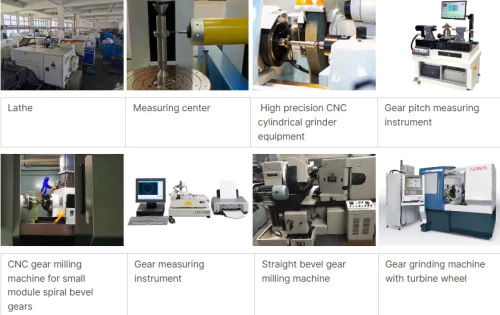
Heat treatment is not an afterthought — it is the process that converts the raw material’s potential into the gear’s actual operating hardness and fatigue resistance. The same 20CrMnTi steel can produce a gear with 200 HB surface hardness (suitable only for low-speed light-load drives) or 60 HRC surface hardness (suitable for automotive differential duty cycles) depending on what heat treatment is applied after machining.
Material Selection by Application: A Decision Framework
The following decision logic distils the material selection considerations into a practical starting point. Always validate against formal ISO 6336 or AGMA 2001 calculations before finalising the specification for safety-critical applications.
🚗 Automotive & Trucks
First choice: 20CrMnTi carburised. High-cycle fatigue, shock loading from road impacts, and 200,000 km+ service life requirement — this is the definitive specification. Second choice: 18CrNiMo7 for extreme performance applications.
⛏️ Mining & Construction
First choice: 42CrMo nitrided for fatigue-limited drives. 20CrMnTi carburised where impact loading dominates. Dacromet or Geomet surface coating for outdoor WA/QLD installations.
🍞 Food & Pharma
First choice: 316L stainless for wash-down and food-contact environments. POM polymer for light drives where self-lubrication eliminates lubricant contamination risk entirely.
🌬️ Wind Energy
First choice: 42CrMo nitrided with fatigue life documentation to support 20-year turbine life certification. Material traceability to mill certificate required by AEMC compliance frameworks.
⚓ Marine
First choice: 17-4PH stainless (H900) for propulsion and steering drives on Australian coastal and offshore vessels. 316L acceptable for low-load auxiliary applications.
🔬 Medical & Lab
First choice: 316L stainless for autoclave-compatible surgical drives. PEEK for polymer options requiring autoclave or gamma sterilisation. POM for EtO-compatible lab automation drives.
Related Product: Precision Spiral Bevel Gears
Material selection decisions are most consequential for high-duty spiral bevel gears, where the combination of contact stress, bending fatigue, and thermal loading pushes material properties to their limits. Australia Ever-Power’s precision spiral bevel gears are available in the full material range described in this guide — from C45 carbon steel through to 316L stainless and engineering polymer grades — with heat treatment and surface treatment options matched to your specific application environment. All spiral bevel pairs are supplied as matched, lapped sets with contact pattern certification.
Customer Experiences with Australia Ever-Power Material Selection
“We had been specifying C45 steel for our agricultural PTO bevel gears and were seeing field failures after two harvest seasons. Australia Ever-Power recommended switching to 40Cr with induction hardening — tooth root stress was within range but surface contact stress was the failure mode. Six seasons in, zero returns from that batch.”
“The material traceability documentation for our 42CrMo wind turbine bevel sets was complete and accepted by our AEMC compliance reviewer without any queries. That’s not something we’ve experienced with all suppliers. It saved us considerable time on the certification side of our SA wind farm expansion.”
“We moved our food mixer bevel gears to POM grade as recommended. The lubricant contamination issue we’d had with stainless steel gears disappeared completely — no more product holds. The four-star rating is only because the first sample lead time was slightly longer than quoted, though subsequent batches have been on schedule.”
“The team’s knowledge of 17-4PH stainless for our marine steering gear application was exactly what we needed. They understood the H900 condition requirement without explanation and provided the material cert with Charpy impact data at -18°C for our Lloyd’s Survey submittal. Hard to find that level of material awareness in a gear supplier.”
Australia Ever-Power vs Generic Suppliers: Material Quality Comparison
Frequently Asked Questions
Need Help Selecting the Right Material for Your Bevel Gear?
Australia Ever-Power | 27 Harley Crescent, Condell Park NSW 2200 | [email protected]