
Vibration in a bevel gear drive is not simply an annoyance — it is mechanical energy being diverted from useful work, and it accelerates every form of gear damage: tooth surface fatigue, bearing spalling, seal wear, and housing fatigue cracking. Studies of Australian industrial maintenance records show that vibration-related damage accounts for approximately 28% of unplanned bevel gearbox overhauls in mining and manufacturing operations. Yet many of those failures are avoidable through systematic adjustment of five controllable factors during installation, commissioning, and routine maintenance. This guide examines the root causes of bevel gear vibration and provides concrete, step-by-step corrective methods that Australian maintenance engineers can apply without specialist vibration analysis equipment.
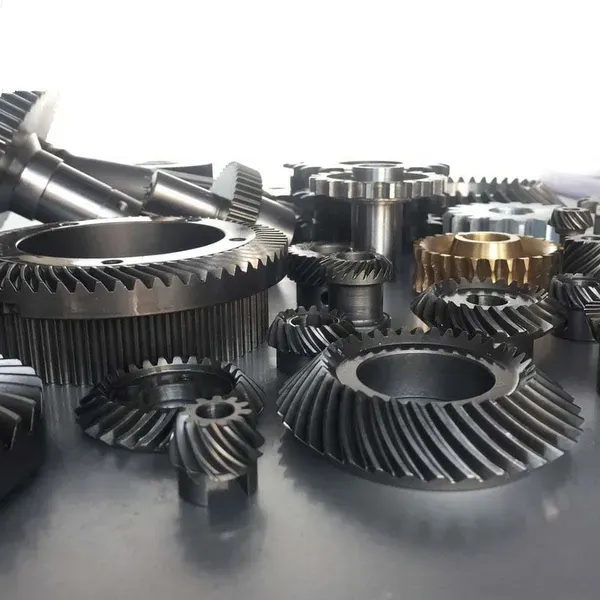
Understanding Bevel Gear Vibration: Sources and Frequencies
Vibration in a bevel gear drive originates at the tooth mesh — the point where load transfers from driving to driven gear tooth. In a perfectly manufactured, perfectly installed bevel gear pair with infinite housing and shaft stiffness, zero vibration would be generated. In the real world, the gap between this ideal and actual conditions determines the vibration level. Three fundamental sources dominate:
📊 Transmission Error
Fluctuation in instantaneous gear ratio caused by tooth profile geometric errors. Produces vibration at mesh frequency and harmonics. Reduced by higher accuracy grade (DIN 5–6) and lapping to optimise contact pattern.
⚡ Dynamic Load Amplification
At certain speeds, gear mesh frequency coincides with the natural frequency of the gear-shaft-housing system, amplifying vibration by 5–20×. Avoiding resonance speeds by design or detuning the system by changing gear tooth count or shaft stiffness.
🔩 Installation Errors
Incorrect mounting distance, inadequate bearing preload, and housing misalignment cause edge loading — concentrating contact at tooth tips or heels and generating impulse vibration at each tooth engagement.
🔄 Imbalance and Eccentricity
Mass imbalance in the gear or attached components (couplings, sheaves, fans) produces vibration at shaft rotational frequency. Gear runout from bore eccentricity produces once-per-revolution variation in backlash and load — generating sub-mesh-frequency vibration.
Method 1 — Correct the Tooth Contact Pattern
The tooth contact pattern is the single most important factor governing bevel gear vibration, and it is adjustable during installation without any new parts. An incorrectly positioned contact pattern — at the toe (small end), heel (large end), top, or root of the tooth — concentrates load on a fraction of the tooth face and creates high local stresses that excite vibration at mesh frequency.
Step-by-Step Contact Pattern Correction
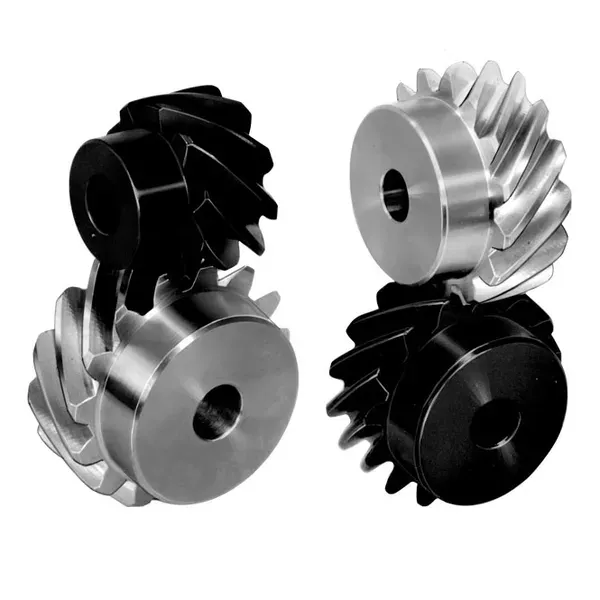
Method 2 — Set Bearing Preload Correctly
Bevel gear shafts are supported by angular contact or taper roller bearings that must be preloaded to maintain correct gear mounting distance under all operating conditions. If bearing preload is set too low, the gear pair moves axially under load — shifting the contact pattern and generating vibration that changes character with load direction. If preload is too high, bearing drag generates heat and accelerates bearing fatigue.
The target preload for taper roller bearings in bevel gearbox applications is typically expressed as shaft end-play of 0.02–0.05 mm. Measure with a dial indicator on the shaft end while applying 50–100 N axial force alternately in both directions. Values below 0.02 mm indicate over-preload; above 0.10 mm indicates insufficient preload or bearing wear.
For gearboxes that have been in service, bearing wear gradually reduces preload — the shaft end-play increases above the allowable limit, the gear pair separates under load, and vibration increases progressively. Australian maintenance programmes should include shaft end-play measurement at each planned overhaul interval (typically every 4,000–8,000 operating hours for industrial bevel gearboxes). Restore preload by adding or replacing bearing spacers or shims per the OEM service specification before full vibration develops.
Method 3 — Optimise Backlash to the Correct Range
Backlash — the clearance between non-driving tooth flanks — has a direct and quantifiable effect on bevel gear vibration. Too much backlash allows the driven gear to oscillate freely through the clearance during load reversals, producing impulsive vibration at the reversal frequency. Too little backlash causes thermal binding as the gear heats up during operation, generating a continuous rattling vibration as tooth pairs cyclically bind and release.
Backlash Specification Guide
Measure backlash at the pitch radius with a dial indicator mounted tangentially to the gear rim while holding the pinion stationary. In Australian outdoor equipment operating in summer heat — ambient above 40°C in QLD and WA — gear housing temperatures can reach 80°C at steady state. Allow for thermal expansion by setting cold backlash 0.02–0.05 mm above the minimum specified, depending on housing temperature differential above ambient.
Method 4 — Address Housing and Foundation Resonance
Even a perfectly installed bevel gear set can produce excessive vibration at the gearbox structure if the gear mesh frequency coincides with a natural frequency of the housing, mounting frame, or connected piping. This phenomenon — resonance — amplifies vibration by factors of 5–20×. A drive that runs quietly at 900 rpm may become severely vibrate at 1,000 rpm if the housing natural frequency is near the 1,000 rpm mesh frequency for the tooth count.
Diagnosing Housing Resonance
Signature: vibration increases suddenly at a specific speed and decreases above it — unlike gear mesh vibration, which tracks proportionally with speed. Run the drive through a speed sweep (if variable speed is available) and note where peak vibration occurs relative to the mesh frequency. If vibration peaks at a frequency not directly related to shaft speed × tooth count, resonance is the likely cause.
Detuning Strategies
- Change operating speed: If the drive speed is not fixed, adjust to move the mesh frequency away from the resonance. A 10–15% speed change typically provides adequate separation.
- Add stiffening to the housing: Gussets or additional mounting bolts increase housing natural frequency, moving it above the mesh frequency operating range.
- Install vibration-isolating mounts: Elastomeric mounts between gearbox and baseplate decouple the housing from the structural resonance. Effective for structure-borne noise and vibration in Australian food processing and pharmaceutical plants where noise transmission to adjacent sensitive areas is a concern.
- Add mass to the housing: Increasing housing mass (within practical limits) lowers natural frequency and reduces resonance peak amplitude through increased damping.
Method 5 — Upgrade Gear Accuracy Grade and Surface Finish
When the preceding installation and mechanical adjustments have been optimised and vibration remains above acceptable levels, the root cause is typically transmission error from inadequate gear accuracy — the gear’s tooth profile deviates enough from the theoretical involute/spiral that instantaneous gear ratio fluctuates measurably at each tooth engagement. The only resolution is replacing the gear set with a higher-accuracy grade.
For bevel gear drives operating above 5 m/s pitch line velocity, DIN Grade 8 is the minimum for acceptable vibration, and DIN Grade 6 (precision ground) reduces mesh-frequency vibration by 6–10 dB(A) compared to Grade 8. The corresponding reduction in transmitted vibration to connected structures and bearings extends bearing life by a factor of 1.5–3.0× at equal speed and load.
Surface finish also contributes: a tooth flank roughness of Ra 0.4 µm (fine-ground or superfinished) supports a thicker EHL lubricant film than Ra 1.6 µm (as-cut), and the thicker film damps micro-vibration from asperity contact. For drives where the lambda ratio is marginal (film thickness borderline relative to surface roughness), upgrading surface finish is often as effective at reducing vibration as upgrading gear accuracy grade — at lower cost.
Vibration Diagnosis Quick Reference
Use this table to quickly identify the most likely cause based on the vibration character observed during operation.
Industry Applications: Where Vibration Control Matters Most
- CNC Machining Centres (Sydney, Melbourne, Brisbane): Vibration from bevel gear drives in CNC spindle head and tool change mechanisms directly degrades surface finish quality and dimensional accuracy. DIN Grade 6 spiral bevel gears with ISF finish are now specified in premium Australian machining centres to achieve submicron surface finish requirements.
- Printing Machinery (VIC, NSW): Register accuracy in web offset printing requires bevel gear drive vibration below 0.5 µm — achievable only with precision-ground DIN Grade 5–6 spiral bevel gears and rigidly mounted housings with vibration isolation from the press frame.
- Pharmaceutical Packaging (all major cities): GMP manufacturing guidelines require vibration levels that do not affect fill accuracy or seal integrity. Polymer bevel gears (POM, PA66) self-damp vibration by 5–12 dB(A) compared to steel — making them preferred for light-load pharmaceutical packaging drive applications.
- Mining Conveyors (WA, QLD): Belt conveyor head drives using bevel gearboxes generate vibration that propagates through the belt and structure. Excessive vibration at mesh frequency can cause belt splice fatigue failure — a costly stop in continuous mining operations. Correct contact pattern, adequate backlash, and regular bearing preload checks are the minimum maintenance programme for Australian continuous mining conveyor bevel gearboxes.
- Solar Tracker Drives (SA, QLD, WA): Single-axis and dual-axis solar tracker bevel gear drives operate at very low speeds (0.001–0.01 rpm tracking) where dynamic vibration is not a concern, but structural vibration from wind loading can cause fretting wear at the gear mesh if backlash is insufficient to accommodate thermal expansion and wind-induced deflection. Specifying generous backlash (upper end of the allowable range) for outdoor solar tracker bevel gears prevents this fretting mechanism.
Related Product: Precision Spiral Bevel Gears for Low-Vibration Drives
For vibration-sensitive applications, Australia Ever-Power’s precision spiral bevel gears in DIN Grade 6 with full contact pattern certification represent the lowest-vibration production bevel gear configuration available. Each matched pair is supplied with the contact pattern photograph and backlash measurement — providing installation baseline data against which any future vibration increase can be assessed. Contact [email protected] for a vibration-specific gear specification review.
Australia Ever-Power vs Other Suppliers: Vibration Support
Customer Experiences
“We had a new bevel gearbox on a CNC milling head that vibrated visibly from day one of operation. Following the contact pattern check procedure, we found the pinion was 0.15 mm too far from the gear — heel contact on both flanks. Three shim changes later, vibration dropped from 8.2 mm/s to 0.9 mm/s. No gear replacement required.”
“Our conveyor head drive bevel gearbox developed increasing vibration over six months. Shaft end-play was measured at 0.18 mm — well above the 0.05 mm maximum. Replacing the taper roller bearings and restoring correct preload completely resolved the vibration. The Australia Ever-Power bearing selection guide matched our housing dimensions exactly.”
“We identified resonance as the cause of vibration in our pharmaceutical packaging line bevel drives — it peaked sharply at 850 rpm and was barely noticeable above or below. Elastomeric mounts solved it completely. Australia Ever-Power confirmed our diagnosis and recommended the mount specification. Four stars only because the mount lead time extended our maintenance window slightly.”
“Upgraded our web offset press bevel gear sets from DIN Grade 8 lapped to DIN Grade 6 ground spiral bevel pairs from Australia Ever-Power. Register error on the press dropped from ±0.08 mm to ±0.03 mm immediately. The investment paid back within three print runs from reduced waste.”
Frequently Asked Questions — Bevel Gear Vibration
Reduce Bevel Gear Vibration with Precision-Graded Sets from Australia Ever-Power
27 Harley Crescent, Condell Park NSW 2200 | [email protected]