
Premature bevel gear wear is one of the most expensive and frustrating maintenance problems in Australian industrial facilities. Conveyor drives on Queensland coal mines, agricultural PTO gearboxes on South Australian headers, and marine steering bevel drives along the WA coast all share the same problem: gear sets that should last three to five years are failing in twelve to eighteen months. In almost every case, the cause is identifiable, preventable, and correctable — if you know what to look for. This guide covers every significant root cause of premature bevel gear wear, with clear diagnostic signs, corrective actions, and a structured maintenance schedule to prevent recurrence.
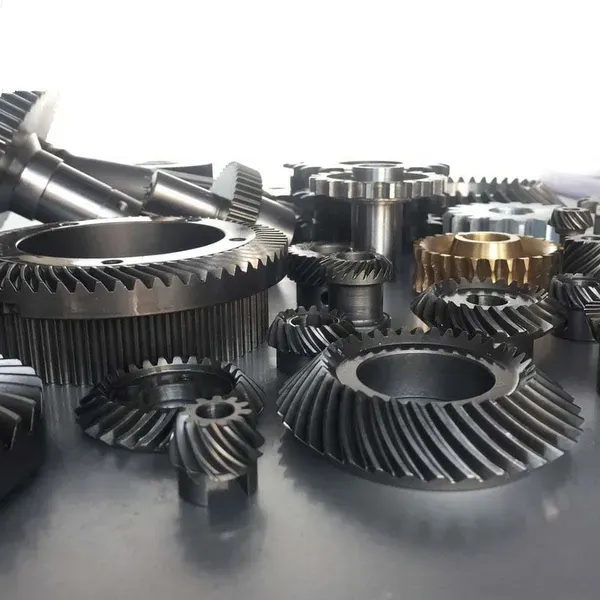
The Three Primary Failure Modes: How to Identify What Is Actually Going Wrong
Before reaching for the phone to order replacement gears, the most important step is identifying the failure mode from the worn gear’s appearance. The corrective action for abrasive wear is completely different from the corrective action for pitting fatigue — ordering the same spec replacement without addressing the cause guarantees the same failure repeating in the same timeframe. The three primary bevel gear failure modes encountered in Australian industry are:
Surface Fatigue (Pitting)
Appearance: Small craters (0.5–3mm) concentrated near the pitch line. Subsurface cracks visible in progressive stage. Gear flanks have a “cratered” texture below the original surface.
Root cause: Hertz contact stress exceeds material fatigue limit. Usually: wrong (too low) pressure angle, undersized module, hard-to-hard contact without adequate case depth, or oil film breakdown at the pitch line.
Abrasive Wear
Appearance: Directional scratches or polished grooves across the full tooth flank surface, following the sliding direction. Uniform material removal across the face. No craters.
Root cause: Hard particles in the lubricant (contamination) or metal wear debris from inadequately run-in teeth cutting abrasive scratches into the flank surface. Also occurs with insufficient lubricant film thickness (wrong viscosity or oil starvation).
Tooth Root Fatigue (Bending Fracture)
Appearance: Crack at the tooth root fillet on the tensile side, perpendicular to the tooth direction. May progress to complete tooth fracture. Fracture surface shows fatigue beach marks (progressive cracking) and a final fast-fracture zone.
Root cause: Tooth root bending stress exceeds material fatigue limit. Usually: overload event (stall/jam), undersized module, tooth root undercut from too few teeth, or material deficiency (inadequate case depth or insufficient case hardness).
Cause 1: Misalignment and Contact Pattern Errors — The Hidden Driver of Bevel Gear Wear
Misalignment is the single most under-diagnosed cause of premature bevel gear wear in Australian industrial practice. Unlike a bearing failure or oil leak, misalignment produces no obvious immediate symptom — the drive runs, the machine operates, and the gear appears to function normally. It is only after six to eighteen months of accelerated wear that the problem becomes visible in the form of pitting, scoring, or fracture concentrated at one end of the tooth face. By that stage, replacement is inevitable and the cause is typically misidentified as “gear quality” or “overloading” rather than the original alignment problem.
Types of Bevel Gear Misalignment and Their Specific Wear Signatures
How to Perform a Contact Pattern Check Without Disassembling the Drive
The simplest diagnostic for bevel gear misalignment is the contact pattern check using engineers’ marking compound (Prussian blue or white marking paste). Apply a thin coat of compound to 3–5 teeth on the gear (larger wheel). Rotate the gearbox slowly by hand through 5–6 full rotations under light resistance (apply light brake by hand to the output shaft — do not use motor drive). Disassemble and inspect the tooth flanks on both the gear and pinion. A correctly aligned bevel gear pair shows an elliptical contact mark positioned centrally in the face width and centrally between the tooth root and tip. Contact shifted toward the toe, heel, tip, or root indicates the type of misalignment described in the table above. This test can be performed at any service interval without special instrumentation and provides direct evidence of alignment quality that no other simple measurement can duplicate.
Cause 2: Lubrication Failure — the Largest Single Cause of Preventable Bevel Gear Wear
Lubrication failure accounts for an estimated 50–65% of all premature bevel gear failures seen in Australian industrial maintenance practice, based on failure analysis data from repair and replacement work. This is a remarkably high proportion for a problem that is almost entirely preventable with the correct oil specification, adequate oil volume, clean oil, and a routine oil change schedule. The following covers every lubrication failure mode that leads to premature bevel gear wear, with the specific diagnostic sign that distinguishes each mode from the others.
Wrong Oil Viscosity
Diagnostic sign: Polished tooth flanks with directional scratch marks; no pitting; oil sheen appears thin and runny at operating temperature.
Solution: Check OEM viscosity specification. Most industrial bevel gear drives at 20–40°C ambient require ISO VG 220 mineral or PAO synthetic. Higher ambient or high-speed applications may need VG 320. Using hydraulic oil or engine oil instead of gear oil is a common wrong-viscosity error in Australian field workshops.
Oil Overheating and Degradation
Diagnostic sign: Dark brown or black oil with acrid smell; varnish deposits on housing interior walls; bearing and gear wear accelerating simultaneously.
Solution: Fit an oil temperature monitor (alarm at 90°C, shutdown at 100°C for mineral oil; 100°C / 120°C for PAO). Verify cooling is adequate for the duty cycle. Change to a synthetic PAO grade with higher oxidation resistance. Investigate if reduced output speed (higher gear ratio) is possible to reduce churning losses.
Water Contamination
Diagnostic sign: Milky white oil emulsion; orange-brown rust patches on tooth flanks; pitting with corrosive appearance (irregular rather than classic circular pits).
Solution: Replace worn shaft seals immediately; drain and refill with fresh oil; fit a sealed breather-desiccant filter; investigate the water ingress path (condensation, pressure washdown, flooding). In outdoor applications (agricultural, solar), fit labyrinth seals as primary seal with lip seal as secondary.
Particle Contamination
Diagnostic sign: Severe abrasive scratching across full tooth face in the sliding direction; particles visible in drained oil; rapid increase in oil particle count on spectrographic oil analysis.
Solution: Fit a full-flow oil filter if the housing volume permits; implement quarterly oil sampling and particle count monitoring; use clean oil filling equipment rather than open-top jugs. In dusty environments (mining, quarrying), use sealed breather filters rated to ISO 4406 Class 16/14/11 or better.
Insufficient Oil Level
Diagnostic sign: Scoring lines at the pitch line concentrated at the gear’s large end (heel); rapid temperature rise from cold start; normal bearing temperatures but high gear housing temperature.
Solution: Check oil level with gearbox cold and stopped, on a level surface. Fill to the correct mark — overfilling causes excessive churning and heat. Investigate why oil level dropped: seal failure, drain plug leak, or incorrect initial fill. Fit a remote sight glass if the standard one is inaccessible.
Wrong Oil Type (Hypoid vs Standard)
Diagnostic sign: Extreme scoring (scuffing) of hypoid gear tooth flanks; rapid tooth surface destruction despite adequate oil level and correct viscosity.
Solution: Hypoid bevel gears require an EP (extreme pressure) gear oil — API GL-5 specification — due to the high sliding velocity at the tooth contact. Standard GL-4 oil or non-EP gear oil will cause rapid scoring of hypoid tooth flanks. Always verify the original OEM lubricant specification and use the correct API service classification.
Cause 3: Overload and Undersized Specification — When the Gear Was Never the Right Size
One of the most common findings when Australia Ever-Power’s engineering team reviews a chronic premature wear problem is that the bevel gear was undersized from the very beginning — not because the designer was incompetent, but because the application factor (k_a) used in the original design did not reflect the real operating load profile. Nominal rated power is not the design load for a bevel gear. The design load is the nominal torque multiplied by the application factor, which accounts for starting torques, shock loads, jam/stall events, and dynamic amplification from drivetrain resonances.
Common Application Factor Underestimation Scenarios in Australian Industry
A conveyor jam produces a near-instantaneous torque spike up to 5–8× nominal as the belt tension peaks before the motor protection trips. If the gear was designed for k_a = 1.5 and experiences a 5× overload, the instantaneous tooth root stress exceeds the design value by 3–4×. Each jam event causes fatigue damage that accumulates over time — even if the tooth does not fracture immediately.
PTO-driven implements connected to a tractor with a direct-on-line engagement clutch produce a shock load at engagement that can reach 3–5× the steady-state PTO torque. Agricultural bevel gear gearboxes designed only for continuous running loads will fail from bending fatigue at the pinion root after 200–400 engagement cycles.
Solar tracker bevel gear drives designed for nominal actuator torque only are frequently undersized for high wind gust loading. A 50-year storm wind event on a large tracker panel can produce torques 8–12× the nominal actuator torque through the aerodynamic moment arm. Without a torque-limiting coupling, this overload passes directly through the bevel gear set.
Crane slewing drives operate in start-stop cycles that produce peak torques at acceleration and deceleration. Dynamic loading from rope swing and pendulum effect of the suspended load adds to the drive torque. A k_a of 2.0–2.5 is appropriate for most Australian crane slewing bevel drives; k_a = 1.25 (which appears on some imported crane gearbox specifications) is not adequate.
Solutions for overload-driven premature wear: The most effective solutions are (1) fit a torque-limiting coupling set at 1.75–2.0× nominal torque to physically prevent overload from reaching the gear; (2) upgrade to a higher module that correctly accounts for the peak load with k_a applied; or (3) specify a higher-strength material (18CrNiMo7-6 instead of 20CrMnTi) to increase the bending fatigue limit at the existing module. Solutions (1) and (2) together represent the standard approach for Australian mining conveyor drives that are experiencing repetitive bending fatigue failures.
Cause 4: Manufacturing and Material Defects in Bevel Gears
When the failure mode analysis, alignment check, lubrication review, and load calculation all show no obvious problem — when the drive appears correctly specified, correctly aligned, and correctly lubricated — but the gears still fail prematurely — the cause is almost always a manufacturing or material deficiency in the gears themselves. This is particularly common with low-cost imported bevel gears ordered without quality documentation. The specific defects that cause premature failure are:
Target case depth for standard industrial bevel gears: 0.8–1.5mm (module-dependent). Under-carburised gears have a thin hard case over a soft core — pitting penetrates through the case into the soft core quickly, accelerating failure from incipient to destructive pitting within weeks rather than months. Detection: Hardness traverse measurement on a cross-section sample. Request case depth report from supplier for every batch.
Target surface hardness for carburised case-hardened bevel gears: HRC 58–62. Gears hardening to only HRC 50–54 (from inadequate carburising atmosphere, quench rate, or post-carburising tempering temperature error) have contact stress capacity approximately 35–45% below specification. Detection: Rockwell hardness check on tooth surface. Minimum 5 measurements per gear, average and range reported.
Profile errors beyond the specified quality grade (ISO quality 8 or coarser) produce non-uniform tooth contact that concentrates load on small portions of the tooth face. This acts like a continuous misalignment source that cannot be corrected by shimming. Detection: CMM tooth profile measurement. Request full profile inspection report — not just a tooth caliper measurement — for gears in critical applications.
Gears supplied as 20CrMnTi or 18CrNiMo7-6 that are actually a lower-alloy grade (C45 through-hardened or shallow-case 20Cr without Ni or Mo) will meet dimensional specifications but fail the material fatigue tests that underpin the design calculation. Detection: Mill certificate from the steel supplier (the raw material supplier, not the gear manufacturer). Spark testing or XRF analysis on received gear material is a cost-effective field check for bulk procurement.
Maintenance Schedule to Prevent Premature Bevel Gear Wear
A structured maintenance routine addressing all four root cause categories — misalignment, lubrication, overload, and material quality — extends bevel gear service life to its designed potential in every application from agricultural drives in South Australia to mining drives in the Pilbara. The following schedule is calibrated for standard Australian industrial duty cycles.
Weekly
Oil level check (sight glass, gearbox cold and stopped). Listen for pitch change in running noise — any new whine, knock, or rumble is an early warning. Monitor oil temperature at steady-state operation. Record and compare to baseline.
Monthly
Oil particle count sample (spectrographic oil analysis — SOA). Check seal integrity; inspect for oil leaks. Verify all mounting fastener torques. For outdoor drives: check breather filter condition and clean or replace if partially blocked.
6-Monthly / 2,500 hr
Full oil change. Flush housing with flushing oil before refilling if contamination was detected. Visual tooth inspection via inspection port or by partial disassembly — check for pitting (pit size and coverage), abrasive scoring, and contact pattern position. Photograph and record.
Annual / 5,000–10,000 hr
Full disassembly inspection: measure backlash (compare to original specification); check bearing preload and rolling element condition; perform contact pattern check (marking compound); inspect seals and replace as standard regardless of visual condition; check housing bore alignment if wear pattern suggests misalignment.
When and How to Replace Worn Bevel Gears: A Practical Decision Guide
Knowing when to replace versus when to monitor is a judgement call that affects maintenance budget and production availability. The following criteria are based on ISO 10300 wear limit guidelines adapted for Australian industry practice.
Related Components That Wear Alongside Bevel Gears and Must Be Inspected Simultaneously
- Taper Roller Bearings: In any drive with premature bevel gear wear, inspect bearings for spalling, pitting, or cage fracture. Bearing failure produces debris that accelerates gear wear. Replace bearings as a standard item at every gear replacement — bearing failure shortly after new gears are fitted is a common and preventable cause of repeat failures.
- Shaft Seals: Seal wear is a primary cause of oil contamination, oil loss, and water ingress — all leading causes of lubrication failure. Replace seals at every major service regardless of visible condition. Use upgraded seal materials (FKM/Viton instead of NBR) for high-temperature applications or chemical environments.
- Housing Bores and Seating Faces: In high-vibration applications, bearing outer ring fretting (fretting corrosion of the housing bore seat) is common. If the bearing outer ring can move in the housing bore under operating loads, it will allow shaft misalignment under load — which directly causes tooth contact errors as described in the misalignment section.
- Breather/Vent Filter: A blocked breather causes internal pressure build-up that forces oil out through seals, causing low oil level and seal degradation simultaneously. In dusty environments (mining, quarrying, construction), breather filters should be inspected monthly and replaced at every 6-month oil change.
- Gear Oil: Flush the housing with clean flushing oil after any gear or bearing replacement before filling with fresh operating oil. Debris from the worn gear pair and disturbed housing surfaces will contaminate new components if the housing is not properly flushed.
- Torque-Limiting Coupling: If the failure root cause was overload, fit a torque-limiting coupling as a priority item at the same time as the gear replacement. Without overload protection, the replacement gear will fail from the same cause in the same time period.
Sustainability: Reducing Premature Replacement Reduces Manufacturing Waste and Carbon Footprint
Every premature bevel gear replacement that could have been avoided represents a measurable environmental cost: manufacturing energy (approximately 18–45 MJ/kg of steel for case-hardened alloy gear production), freight from China to Australia (approximately 0.3 kg CO₂-e per tonne-km at sea freight rates), packaging material, and maintenance vehicle fuel. For a large mining operation replacing bevel gear pairs on 60 conveyors every 14 months (instead of the achievable 5 years with correct specification), the avoidable manufacturing and logistics carbon footprint runs to hundreds of tonnes of CO₂-e annually. Correct gear specification, documented quality control, and a structured maintenance regime are tangible, quantifiable ESG improvement measures that Australian companies can report under ASX Climate Reporting guidelines and ACCC sustainability claim requirements.
Total Cost of Premature Wear: Replacement Price vs True Cost
Example costs indicative only. Downtime cost will vary significantly by operation. For a 60-conveyor mining operation, the saving scales to ~$2.2M over 10 years from correct gear specification alone.
Australia Ever-Power: Replacement Bevel Gears with Root Cause Support
Customer Reviews: Solving Premature Wear Problems Across Australia
“We had the same bevel gear set failing every 14 months on our coal conveyor. Australia Ever-Power reviewed photos of the failed gear and immediately identified toe-end pitting consistent with housing bore angular error — not overload as we had assumed. They calculated replacement gears with pitch cone angles matched to our actual 88.4° housing bore. That was 26 months ago and there has been no pitting since. The diagnosis alone was worth every dollar.”
“Our header PTO bevel gearboxes were failing every harvest. Australia Ever-Power identified water contamination from pressure washdowns and provided a sealed FKM lip seal + labyrinth seal combination as the repair recommendation. Also flagged the wrong oil grade (hydraulic oil rather than gear oil). After fitting the correct seals and changing to ISO VG 220 gear oil, we have gone two full harvest seasons with no gearbox failures.”
“I sent a photo of a failed solar tracker bevel gear to [email protected]. The response explained that the pitting pattern — concentrated mid-face but extending toward the toe — was consistent with a too-light module combined with wind-gust overloading. They recommended both a module upgrade and a torque-limiting coupling. Fitted both, and the replacement gears are now past 20 months in the SA desert without any visible wear. The cost of the upgrade was recovered in the first replacement cycle avoided.”
“Contacted Australia Ever-Power after our third bevel gear failure in two years on a materials handling crane. The assessment correctly identified that we were using a non-EP gear oil in a hypoid application — classic mistake that causes scoring. Replaced oil and ordered correctly specified replacement gears. No failures in 18 months. The diagnosis was correct and the delivery was on time. Four stars because I’d like a faster online quotation turnaround, but the engineering quality is very good.”
Frequently Asked Questions — Bevel Gear Wear
Stop the Premature Wear Cycle — Get the Right Gear, Right Spec, Right Now
Free root cause assessment · Spec upgrade review · ISO 23509 calculation · Material cert & CMM report
Australia Ever-Power | 27 Harley Crescent, Condell Park NSW 2200 | [email protected]