
The Cross-Industry Reach of Bevel Gear Technology
Bevel gears appear in more industries and more machine types than almost any other mechanical component. Their defining capability — transmitting rotational power between intersecting shafts at angles from 45° to 135° — solves a geometric problem that arises in almost every category of powered machinery. When an engineer needs to redirect drive power around a corner, change shaft orientation to fit within a constrained space, or split drive torque between two outputs at 90° to the input, bevel gears are the solution that standard parallel-shaft gearing cannot provide.
The breadth of bevel gear applications in Australian industry is remarkable: from the underground mining equipment that extracts coal and iron ore in Queensland and Western Australia, to the agricultural machinery that harvests wheat and canola across New South Wales and Victoria, to the marine vessels that work Australia’s extensive coastal and river networks, to the food processing equipment that handles the country’s agricultural output — bevel gears are at work in every sector.
Australia Ever-Power, based in Condell Park NSW 2200, supplies bevel gear sets across all of the industries described in this article. Our engineering team works with customers in each sector to understand the specific operating demands and provide gear sets correctly specified for the application’s load, speed, environment, and service life requirements.
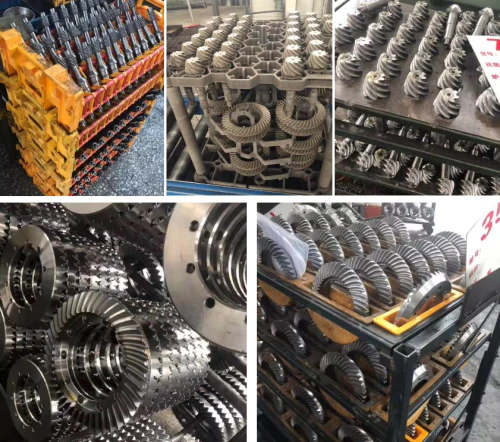
1. Automotive Manufacturing — The Largest Single Demand Sector
The automotive industry is the world’s largest consumer of bevel gears by volume, with every rear-wheel-drive and four-wheel-drive vehicle requiring at least one bevel gear set in its differential assembly. The ring-and-pinion gear inside a rear axle differential uses spiral bevel or hypoid gears to redirect engine torque from the longitudinal driveshaft to the transverse wheel axles — a right-angle power transmission that bevel gears perform at up to 200,000 RPM of output shaft speed in high-performance vehicles.
Key machines: Rear axle differentials, transfer case drive splits, four-wheel-drive front axle differentials, limited-slip differential internals, all-wheel-drive power dividers. The differential bevel gear set also includes the small side gears (spider gears) that allow the two driven wheels to rotate at different speeds when cornering.
Australia’s own automotive aftermarket — replacement differentials for utes, four-wheel-drive vehicles, light commercial vehicles, and agricultural tractors — represents a significant demand for replacement bevel gear sets. The Australian outback and off-road environment is particularly hard on differential gear sets due to extreme temperatures, shock loads from rough terrain, and the cumulative stress of sustained high-torque towing.
2. Mining and Resources — Australia’s Most Demanding Application Environment
Australia’s mining sector — coal in Queensland and NSW, iron ore in WA, gold and nickel across multiple states, copper in Queensland and South Australia — operates the most mechanically demanding equipment in any civilian industry. Underground mining equipment is particularly punishing: continuous miners, longwall shearers, and roadheaders operate in confined spaces with extreme dust contamination, high humidity, vibration from cutting face operations, and shock loads from hard rock or coal inclusions that can spike to many times the rated continuous torque.
Key machines and applications:
- Longwall shearer cutting drums — spiral bevel gearboxes redirect motor torque 90° to the cutting drum axis
- Continuous miner cutting heads — bevel stages inside the cutting drum drive assembly
- Conveyor drive heads — bevel gearboxes in drive corner stations for multi-angle conveyor layouts
- Haul truck differentials — large spiral bevel or hypoid sets in rear axle differentials handling 200+ tonne vehicle gross weights
- Drill rig rotary tables — bevel gear stages in the top drive assembly transmitting drill string rotation
- Load-haul-dump (LHD) vehicles — differentials and transfer cases in underground LHD articulated drive trains
Mining bevel gear specifications are characterised by very high service factors (1.75–2.5), case-carburised alloy steel to minimum AGMA Class 10, and full material traceability documentation required by Australian mine safety regulations. Ever-Power regularly supplies replacement sets to Queensland coal mines and WA iron ore operations with documentation packages meeting AS/NZS and state mining regulator requirements.
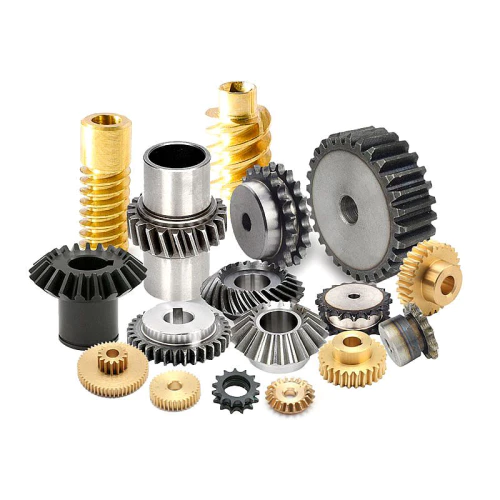
3. Agriculture — Seasonal Intensity, Long Service Life Demands
Australian agriculture — the country’s third-largest export earner — operates enormous fleets of harvesting and tillage machinery across vast distances with limited access to spare parts and repair services. Bevel gears in agricultural machinery must survive the intense seasonal workload of harvest periods, extended idle periods between seasons, and operation in environments laden with fine grain dust, soil, and crop residue that challenge every sealing system.
Key machines:
- PTO-driven implement gearboxes — every rotary tiller, mower, spreader, and hay baler connected to a tractor PTO uses a bevel gear stage to redirect PTO shaft power to the working element
- Harvester header drives — bevel gearboxes in combine harvester header assemblies transmitting cutting reel and auger drives from the main gearbox
- Fertiliser spreader drives — bevel gear stages in spinning disc drive assemblies
- Irrigation system drives — centre-pivot and lateral-move irrigation systems use bevel gearboxes at tower drive assemblies to convert the vertical motor output to the horizontal wheel drive
- Feed mixer drum drives — vertical TMR (total mixed ration) mixer wagons use bevel gear stages to connect the horizontal PTO input to the vertical mixer auger
Agricultural bevel gears are often the most cost-sensitive of all industrial bevel gear applications, so straight bevel gears are common in lower-speed PTO applications where their manufacturing cost advantage outweighs the performance benefits of spiral bevel gears. For higher-speed implements and combine harvester applications, spiral bevel gears are standard.
4–10. Additional High-Use Industries: Applications at a Glance
Stern drives, Z-drive thrusters, anchor windlasses, and deck cranes. Marine-grade stainless or sealed alloy steel bevel gears in housings rated for saltwater exposure. Drives propulsion and all major deck machinery on commercial and naval vessels.
Helicopter rotor gearboxes, aircraft actuator drives, missile steering mechanisms. Highest material specifications, superfinished tooth surfaces, and full DO-160/MIL-spec documentation. Australia’s defence procurement requires full traceability.
Industrial mixers, filling machines, conveyor corner drives, and meat processing lines. Stainless steel bevel gears with NSF H1 lubricants meeting FSANZ requirements. Frequent washdown and chemical cleaning exposure demand sealed, hygiene-rated designs.
Wind turbine yaw and pitch drives, hydro turbine governors, gas turbine accessory gearboxes. Australia’s expanding wind farm sector in SA, VIC, and WA creates ongoing demand for spiral bevel yaw drive gear sets with 20+ year fatigue life design requirements.
Excavator final drives, crane slewing rings, concrete mixer drum drives, road paver drives. High shock loads and abrasive environments require case-carburised spiral bevel gears with AGMA service factor ≥ 1.5 and robust sealed housings resistant to mud and concrete contamination.
Traction gearboxes on EMU and locomotive bogies use spiral bevel stages. Escalator drives, cable car mechanisms, and airport people-mover systems also incorporate bevel gear stages. Long service life (30+ years) drives demand for high-precision, well-documented gear specifications.
Milling machine heads, radial drill quill drives, and boring mill tables use mitre and straight bevel gear stages to redirect spindle drive through 90°. Precision positioning applications specify zerol bevel gears for minimal backlash and zero net axial thrust on spindle bearings.
Sluice gate actuators, pump station right-angle drives, and aeration basin impeller drives use bevel gears in wet, corrosive environments. Sealed stainless or coated housings with food-safe or marine-grade lubricants are standard for water treatment applications.
Industry Pricing Reference (AUD — Indicative)
Pricing reflects single-pair, custom-manufactured spiral bevel gear sets representative of each industry’s typical specification. Enquire at [email protected].
| Industry / Application | Typical Module | AGMA Class | Price / Pair (AUD) |
|---|---|---|---|
| Automotive differential (replacement) | 3–5 | 9–10 | $400–$1,200 |
| Agricultural PTO gearbox | 4–6 | 7–9 | $350–$900 |
| Mining shearer / conveyor drive | 6–12 | 10–11 | $2,000–$8,000 |
| Food processing (stainless) | 3–5 | 8–10 | $700–$2,500 |
| Wind turbine yaw / pitch drive | 8–16 | 10–11 | $4,000–$15,000 |
Sustainability and Regulatory Compliance by Key Region
Bevel gear procurement decisions increasingly involve sustainability and regulatory compliance dimensions that vary by country and industry sector. The major markets for industrial bevel gears globally — Australia, the United States, Germany, Japan, China, and the United Kingdom — each have evolving material traceability, environmental, and equipment safety requirements that affect specification and documentation standards.
In Australia, the primary regulatory frameworks affecting bevel gear procurement include the Work Health and Safety Act and associated regulations (requiring equipment to be designed and manufactured to an approved standard), AS/NZS standards for mechanical engineering components, AMSA requirements for marine applications, and state mine safety legislation for mining applications. Food processing bevel gears must additionally meet FSANZ food safety standards, which mandate NSF H1 lubricants and materials compatible with direct and incidental food contact.
From a sustainability perspective, higher-quality bevel gears — correct precision class, correct material and heat treatment — significantly outlast cheaper alternatives, reducing the total material and energy cost of gear production per unit of service life delivered. Australia Ever-Power supports customers’ sustainability reporting by providing material composition data, manufacturing energy documentation, and component lifecycle estimates on request for sustainability assessment purposes.
Customer Case Studies
“Our longwall shearer cutting drum bevel gearbox failed at the face — 200 metres underground, mid-shift. Ever-Power had a replacement set in our depot in 9 days. The documentation matched our mine safety requirements exactly.”
“Switched our food mixer bevel gearboxes to Ever-Power stainless steel units with NSF H1 lubrication. Passed three consecutive HACCP audits without a single gear-related non-conformance. The sealed design eliminated the contamination risk from the previous open housing units.”
“Wind farm yaw drive gears need 20+ year fatigue life. Ever-Power’s AGMA 11 spiral bevel sets with full inspection documentation gave us the design life justification our asset management team required for sign-off.”
“Agricultural PTO gearboxes are hard to source as replacements for non-standard equipment. Ever-Power identified our specification from a sample, manufactured a matched pair, and delivered before the planting season window closed. Excellent.”
Frequently Asked Questions: Industry Bevel Gear Applications
Bevel Gears for Your Industry — Australia Ever-Power
Australia Ever-Power · Condell Park NSW 2200 · Industry-specific bevel gear solutions with the documentation, material quality, and lead times that Australian industry demands.