
Why This Comparison Matters in Real Engineering
The question of whether to specify a bevel gear or a spur gear arises constantly in mechanical design — and it is rarely as straightforward as it first appears. Both gear types transmit rotational power efficiently, both are well-understood and widely manufactured, and both have served industry for well over a century. Yet their mechanical geometry, operating characteristics, and practical applications diverge dramatically.
Spur gears connect shafts that run parallel to one another — the most common configuration in simple machinery. Bevel gears connect shafts that intersect at an angle, typically 90°, redirecting power around a corner. That single geometric difference cascades into significant differences in tooth geometry, load distribution, bearing requirements, noise generation, and manufacturing complexity.
Australia Ever-Power, headquartered in Condell Park NSW 2200, manufactures and supplies both gear types across every major Australian industry sector. The comparison in this article is drawn from both engineering first principles and the real-world performance data our team has observed across hundreds of installed applications throughout Australia and the wider Asia-Pacific region.
Fundamental Geometry: Where Everything Begins
Spur Gear Geometry
Spur gears feature straight, radially-cut teeth arranged parallel to the rotational axis on a cylindrical blank. The tooth profile follows an involute curve — a geometric form that ensures constant velocity ratio transmission regardless of slight centre-distance errors. This involute property makes spur gears forgiving in assembly and easy to manufacture to consistent quality. The entire tooth face makes contact simultaneously across its full width as each tooth pair engages, creating an abrupt load application that generates the characteristic noise of spur gears — particularly audible at higher speeds.
Bevel Gear Geometry
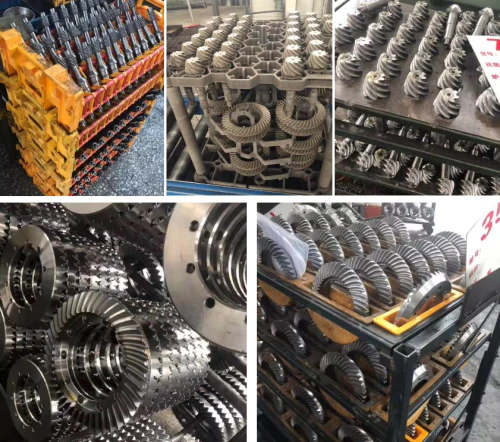
Bevel gears are formed on conical blanks with teeth tapering from a larger outer section to a smaller inner section toward the apex point. This conical geometry allows the pitch surfaces of two mating gears to roll against each other without slipping — the same fundamental requirement as for cylindrical gears, but achieved on intersecting rather than parallel axes. The tooth profile must account for the changing pitch radius along the face width, making bevel gear geometry intrinsically more complex to design and manufacture than the equivalent spur gear. Straight bevel gears have teeth that follow the cone element direction; spiral bevel gears add a curved tooth form that dramatically changes contact and load-sharing behaviour.
Head-to-Head: 9 Performance Dimensions
Bevel Gear Advantages — When They Win
Power Redirection — The Defining Advantage
The capability to transmit power between non-parallel shafts is bevel gears’ defining and irreplaceable advantage. When machine layout requires a change in shaft direction — a vehicle differential, an agricultural PTO drive, an aircraft actuation system, or a marine propeller angle gearbox — no other standard gear type provides this function without adding external couplings, universal joints, or intermediate shafting that reduces efficiency, increases length, and adds failure points. The bevel gear solves this in a single compact unit.
High Load Capacity in Spiral Configuration
Spiral bevel gears achieve contact ratios exceeding 2.0 by combining transverse and face contact ratios, distributing the transmitted load across multiple teeth simultaneously. This produces a dramatic improvement in load capacity per unit of gear size compared to equivalent spur gear pairs at the same module and pitch diameter. For a given torque requirement, a spiral bevel gear set often occupies less axial space than a spur gear alternative — a meaningful benefit in constrained installation envelopes.
Superior Noise and Vibration Performance
Spiral bevel gears engage progressively, with tooth contact beginning at one end of the face and sweeping across as the teeth rotate through mesh. This gradual engagement dramatically reduces the transmission error (deviation from perfectly uniform rotation) that is the fundamental source of gear noise. At the same pitch-line velocity, a well-manufactured spiral bevel gear set typically runs 10–20 dB quieter than a comparable spur gear pair — a night-and-day difference in noise-sensitive applications like passenger vehicles, medical equipment, and office machinery.
Speed Capability
Precision-ground spiral bevel gears can operate at pitch-line velocities exceeding 40 m/s in aerospace and high-speed industrial applications. The same progressive engagement that reduces noise also reduces dynamic load amplification, making spiral bevel gears the preferred choice for high-speed power transmission where spur gears would generate unacceptable vibration and structural fatigue loading at the tooth roots.
Bevel Gear Disadvantages — Where They Fall Short
Manufacturing Complexity and Cost
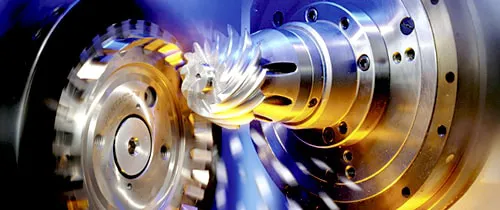
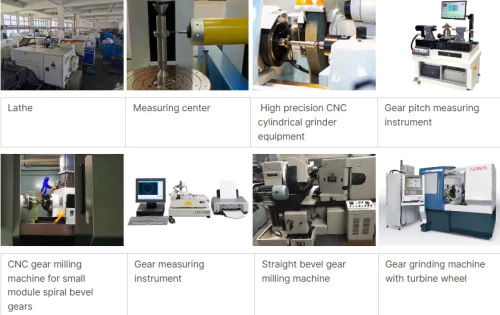
Producing a bevel gear to the same precision class as a spur gear requires significantly more sophisticated machinery, more complex toolpaths, and longer cycle times. The conical blank geometry necessitates specialist machine setups (Gleason, Klingelnberg, or Oerlikon machines for spiral bevel production) not found in every gear manufacturer’s shop. Standard catalogue pricing for bevel gears commonly runs two to five times higher than equivalent-module spur gears, and custom non-standard bevel gear sets may be five to ten times more expensive than comparable custom spur gear sets.
Axial Thrust Bearing Requirements
Every bevel gear pair generates significant axial (thrust) forces at both shafts. These forces increase bearing requirements, necessitate tapered roller or angular contact bearings capable of handling combined radial and axial loads, and require careful preload setting during assembly. A spur gear pair, by contrast, generates no axial thrust whatsoever — the full bearing load is radial, which is managed by simple deep groove ball bearings or cylindrical roller bearings. The additional bearing complexity in bevel gearboxes adds cost, assembly time, and a potential failure mode that spur gear systems simply do not have.
Mounting Sensitivity
Bevel gears are sensitive to mounting distance errors — the position of each gear along its shaft axis affects the contact pattern and backlash directly. Small deviations from the correct mounting distance shift the contact pattern toward the tooth ends, dramatically reducing load capacity and accelerating surface fatigue. Spur gears are far more tolerant of assembly variations: the involute tooth profile provides a degree of insensitivity to centre-distance errors without significant impact on load capacity or noise. This makes spur gears considerably easier to install correctly in field conditions.
Non-Interchangeability of Mating Pairs
In many bevel gear applications, the pinion and ring gear are lapped (run together during manufacturing) and sold and replaced as a matched pair. Running a new ring gear against a worn pinion, or replacing only half of a mated spiral bevel set, produces a contact pattern mismatch that accelerates wear and generates noise even in otherwise sound gearboxes. Spur gear replacements, by contrast, typically allow individual gear replacement without mandatory matched pairing, simplifying maintenance inventory management.
Spur Gear Advantages — Where They Excel
Simplicity and Economy
Spur gears are among the simplest and most cost-effective mechanical power transmission elements available. The straight-tooth involute profile can be generated by hobbing on standard gear hobbing machines found in virtually every gear manufacturing facility in the world. Standard module spur gears are available from catalogue stock in virtually every industrialised country at commodity prices, making them the default choice whenever a machine layout permits parallel shaft transmission and cost is a meaningful constraint.
Highest Efficiency
Well-manufactured spur gears with ground tooth profiles achieve efficiencies of 98–99.5% per mesh stage. Since all tooth contact is rolling contact (no sliding along the profile height at the pitch point), friction losses are minimized. For multi-stage gearboxes in high-power applications where efficiency losses translate directly to energy cost and heat rejection requirements, the slightly higher efficiency of spur gears over equivalent bevel gear stages is a quantifiable advantage over equipment lifespans measured in decades.
Zero Axial Thrust
The absence of any axial tooth force component in spur gears allows the use of simple, economical deep groove ball bearings or cylindrical roller bearings with no preload requirements. Bearing selection, sizing, and replacement are all straightforward. There is no bearing preload sensitivity to manage, no matched shim pack to maintain, and no risk of preload-induced thermal runaway that can occasionally occur in improperly set bevel gearboxes.
Assembly and Maintenance Ease
Spur gear pairs can be installed with basic tools and skills, replaced individually without matched pairing requirements, and inspected visually with straightforward interpretation. For remote or field maintenance environments — agricultural equipment in outback Australia, mining equipment at distant sites — the ability to replace a single spur gear from stock with minimal setup procedure is a meaningful operational advantage over bevel gear systems requiring specialist knowledge and tooling for correct reassembly.
Spur Gear Disadvantages — Their Fundamental Limits
Parallel Shafts Only
The hardest constraint of spur gear design is the absolute requirement for parallel input and output shafts. In many real machine configurations, this constraint forces compromises in shaft layout, increases the overall size of the machine, or necessitates additional transmission components (chains, belts, extra shafts and bearings) to route power around corners. Where a single bevel gear stage could connect two shafts at 90°, a spur gear alternative might require additional bearings, supports, and intermediate shafting — each adding cost, weight, and potential failure points.
Noise at High Speed
The simultaneous full-face contact of spur gear tooth engagement creates impact loading at each tooth mesh cycle, generating noise and vibration that becomes increasingly problematic at higher speeds. At pitch-line velocities above 15–20 m/s, spur gear noise levels become challenging to manage in most applications. Helical gears (a variant of spur gears with angled teeth) are often used to address this, but introduce axial thrust as a trade-off — a compromise that bevel gear designers are also familiar with.
Lower Contact Ratio
Spur gears achieve contact ratios between 1.2 and 1.8 — rarely exceeding 1.8 in practical designs with standard addendum heights. This means that for portions of the mesh cycle, only a single tooth pair carries the entire transmitted load. Load spikes during single-tooth contact periods are a key factor in spur gear fatigue life calculations. Spiral bevel gears, with their combined transverse and face contact ratios, distribute load more continuously and can carry higher mean loads for equivalent gear size.
Decision Guide: Which Gear Type to Specify
- Shafts must intersect at 90° or another non-zero angle
- High torque at medium-to-high speed is required
- Low noise operation is a priority
- Space is constrained in the axial direction
- Application is automotive, aerospace, mining, marine, or agriculture
- A compact right-angle drive is essential to machine function
- Input and output shafts are parallel
- Maximum efficiency per stage is required
- Cost minimisation is the primary driver
- Field serviceability and simple maintenance matter
- Operating speed is below 15 m/s pitch-line velocity
- No axial thrust load on shafts or housings is desired
Market Price Comparison
Indicative pricing (AUD) for standard industrial-quality gear sets. Actual pricing varies with material grade, precision class, quantity, and supplier. Contact Australia Ever-Power at [email protected] for current quotations.
| Item / Size | Bevel Gear Set (AUD) | Spur Gear Set (AUD) | Bevel Premium |
|---|---|---|---|
| Module 2, small (catalogue) | $45–$120 | $12–$35 | ~3–4× |
| Module 4, medium industrial | $180–$450 | $55–$140 | ~3–4× |
| Module 6, heavy industrial | $600–$1,800 | $160–$520 | ~3–4× |
| Module 10, mining/heavy duty | $2,500–$8,000 | $700–$2,200 | ~3–4× |
| Custom precision (AGMA 11+) | POA — from $5,000 | POA — from $1,500 | ~3–5× |
Australia Ever-Power vs Other Suppliers: Why Choose Us
The bevel gear market in Australia is served by a mix of local distributors, import agents, and manufacturers. Understanding where each type of supplier fits helps engineers make the right sourcing decision for their application.
| Capability | Ever-Power | Import Agents | Generic Distributors |
|---|---|---|---|
| Custom non-standard gear sets | ✓ Yes | ✗ Limited | ✗ No |
| Full ISO 10300 load documentation | ✓ Yes | ✗ Rarely | ✗ No |
| Australian-based technical support | ✓ NSW-based | ⚠ Variable | ✗ Often offshore |
| Reverse engineering from sample | ✓ Yes | ✗ No | ✗ No |
| Both bevel and spur gear supply | ✓ Full range | ⚠ Bevel only | ⚠ Spur-focused |
Customer Perspectives
“We had been using spur gears in our conveyor drive for years. When the line was reconfigured and we needed a right-angle drive, Ever-Power helped us select the correct spiral bevel pair. The switch was seamless and the system runs noticeably quieter.”
“Ever-Power supplied both the replacement bevel gear set for our differential and the spur gear reduction stage upstream. Having one technical point of contact who understands both gear types in the same driveline saved us a significant amount of back-and-forth.”
“The comparison documentation on the Ever-Power website helped our graduate engineers understand why the existing machine design used bevel gears rather than the simpler spur gear arrangement one of them proposed. Good technical resource.”
“Needed to upgrade a spur gear stage to handle higher torque loads without changing shaft centres. Ever-Power walked through the options — wider face width, higher-grade material, and helical conversion — much faster than I expected from a regional supplier.”
Frequently Asked Questions
Which is more efficient — bevel gears or spur gears?
Can bevel gears be used in place of spur gears in an existing parallel-shaft machine?
Why are bevel gears so much more expensive than spur gears?
Is a straight bevel gear comparable in noise level to a spur gear?
What is the maximum gear ratio achievable with a single bevel gear stage versus spur gear stage?
Do bevel gears require special lubricants compared to spur gears?
When should I use helical gears instead of either bevel or spur gears?
Can spur gears and bevel gears be used in the same gearbox?
What precision class should I specify for industrial bevel gears?
Where can I source both bevel gears and spur gears in Australia?
Need Help Choosing Between Gear Types?
Australia Ever-Power’s engineering team in Condell Park NSW 2200 provides both bevel and spur gear solutions with full technical support. Reach us for specifications, pricing, and application guidance.